
There might be a purpose to life but answering that question is above my pay grade. An easier question might be is there a purpose to thought?
We don’t know how long it is that humans have been thinking. It’s likely that some form of thinking precedes humanity altogether. Whales and elephants, for example, have been inhabiting earth’s living system for far longer than human beings. The language of whales is yet to be definitively translated, but it clearly carries some complex forms of information, perhaps names and emotions. So too elephants, which use a combination of vocalizations and ground vibrations to communicate information. They carefully examine the exposed bones of deceased elephants, murmuring, and appearing to caress them gently. As to any thinking behind such actions, it too remains a mystery.
One can make a strong case that the thinking of human beings, i.e.: the thoughts about which we are conscious, is entirely about making accurate predictions about the future. Our sensory apparatus perceives, and then our brain records and processes an immense amount of data. Much of that information remains under the surface of our consciousness. For example as we walk, we place one foot in front of the other, and if we are not looking up into the clouds, accurately take successive steps without falling. This represents a type of below-conscious somatic thought in which prior experience about walking on level and semi-level surfaces informs our moment to moment decision-making about taking a future step.
As for conscious thought – today’s stock market and where it’s headed, whether or not the car in front of us is going to take a right or a left turn, what is going to be for dinner, will it be hot tomorrow – all these thoughts are about making accurate predictions because accurate predictions are the key to our survival.
Our thoughts may be primarily in service to an agenda we generally don’t think about much but is always guiding our behavior: basic survival. The nature of survival is quite black-and-white; either we do or we do not survive the arriving moment, it’s really that basic and all about how well we predict outcomes.
Sensitive dependence on initial conditions means predicting outcomes in the natural world is tough enough; for example, will it be a wet or dry winter? Predicting outcomes from the intersection of actions prompted by 8 1/2 billion human imaginations is astoundingly difficult.
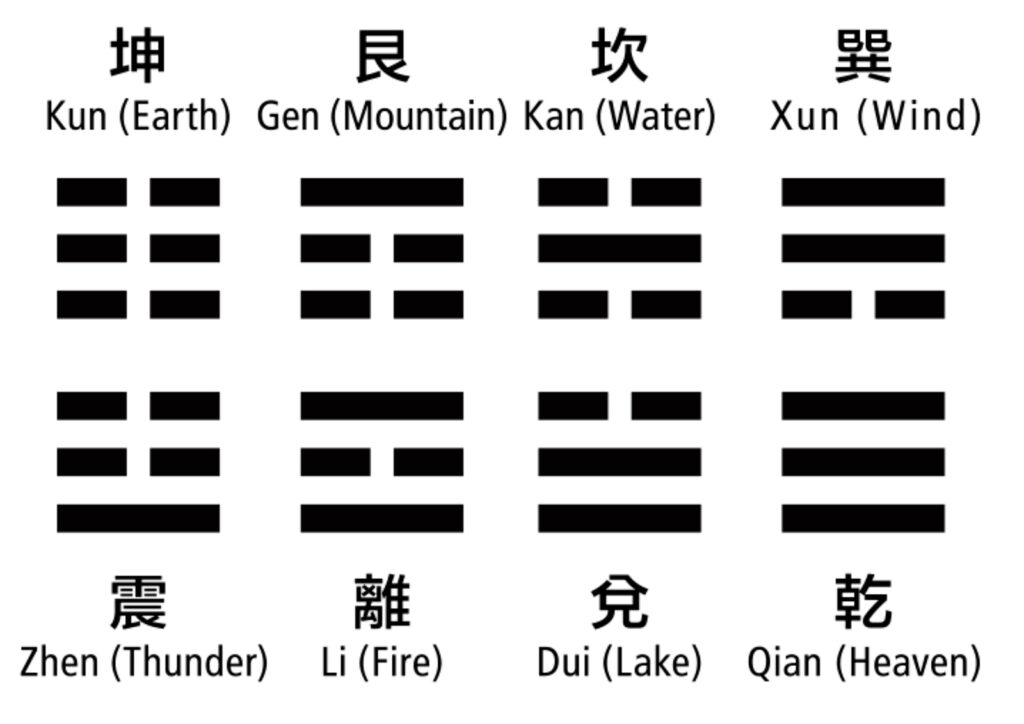
The I Ching, an ancient Chinese text, is also called The Book of Changes. It presents series of patterns represented by 64 hexagrams, each composed of six lines, how some of those lines change, and how to regard such changes. As such, it functions as both an Oracle and a book of advice.
Much of its commentary is based on observations of the dynamic of change in the natural world, and as we inhabit the natural world, patterns of human behavior have also been observed. The changing lines are analogous to how changing lanes potentially alters outcomes through speed and trajectory.
Classical physics provides ways to make fairly reliable predictions about the future, and at our scale of existence is essentially all we need. As Newton observed, the apple doesn’t fall far from the tree, which is a helpful prediction when you’re hungry.
