
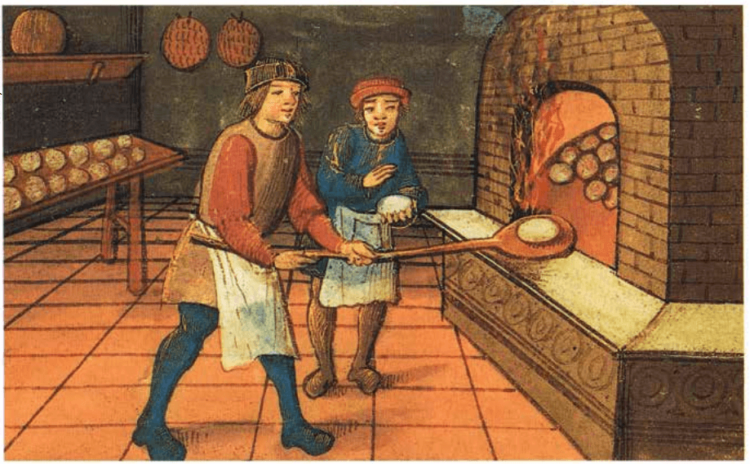
During Europe’s medieval period guilds dominated the working environment; apprentices learned their trade at the feet of a master craftsman. From shoemakers to cooper’s to blacksmiths, a trade was not simply a livelihood, but provided a valuable, stable and reliable place within society. The rise of capitalism, an invention of the Mercantile class, radically altered the relationship between workers, jobs and society. The stage was set for the creation of “labor.”
Labor became a materialist commodity, a representation of humans as capital, and just as the industrial revolution relied on interchangeable parts, so too workers became interchangeable. Capitalism severed working roles from the lifelong security of a career. Vulnerable to being suddenly fired and subject to the momentary whims of “the boss,” wage slavery to a business fundamentally changed the nature of working life. Tethered to a specific location – a factory, a field, an office – interchangeable workers eventually became captives to the most authoritarian institution of modernity, the corporation.
Industrialization dehumanized handicrafts and replaced skilled workers with the assembly line. Wages, benefits, sick leave, vacations; all these became negotiating points in collective bargaining with “labor.” Inevitably, worker dissatisfaction results.
The jobs that people have are in many if not most cases solely to make a living; they provide little in satisfaction, sense of accomplishment, or the feeling that one is making a valuable contribution to society; anthropologist David Graeber called them “Bullshit Jobs.” In addition, many employers treat their workers badly. Labor unions are a natural outgrowth of the dehumanization of the workplace as is the creation of “human resource managers.”
HR departments construct elaborate bureaucratic policies and procedures to deal with everyday, normal human events. The overall message conveyed is that employees cannot be trusted; accordingly, their work activity is monitored, tracked and strictly proscribed. In short, workers have become mere cogs in a machine.
The growing likelihood of autonomous robots replacing human workers looms; it doesn’t get more dehumanized than this. AI is already replacing workers in law, accounting, medicine and entertainment. In time, an AI will be appointed a corporate CEO. Is it too late to consider rehumanizing work and is it even possible? As long as businesses continue to pursue a lower cost of labor, rehumanizing work is nearly impossible.
What would rehumanized work look like? Firstly, it would require trust. The bureaucratic surveillance and minute-to-minute monitoring of workers would have to stop. Secondly, the observations and recommendations of workers would be respected. Thirdly, the ordinary ups and downs of life – sickness, childcare, bereavement, and celebration – would be accepted and accommodated. In short, faith in the basic decency and goodness of people would have to be re-established.
The atmosphere of employer paranoia and suspicion breeds discontent. The whole idea of “managing people” needs to be set aside. People are not livestock and should not be managed as such. Nobody likes to be “managed.” The current paradigm of working – wage slavery – needs to be abandoned.
There are no perfect people, no perfect employers and no perfect workers. At the heart of rehumanizing work is acceptance of this truth and treating each other as decent human beings. Ultimately, such an approach produces trust, generosity, gratitude, sacrifice, and improved mental and physical health. Job turnover decreases, satisfaction improves. Everybody benefits, both employers and workers, and a good human society results.

I think your last paragraph is right: many times we can do well by doing right. Costco is a good example; they pay well and treat employees with respect, who in turn dote on the customers. As a result, they suffer little turnover.
One viable alternative is worker owned coops. Georgia Kelley is a long-time advocate for the Mondragon Cooperative System in Spain.
Jerry
Larry, I read your article about rehumanizing work just after reading another by Robert Reich about the unitary executive theory and the current administration’s push towards a greater authoritarianism (and consequently, the centralization of power and wealth). In this context, your article gave me a glimmer of hope for our grandchildren’s generation, amid the chaos, as it reminded me of the importance of imagining a new world. While we certainly appear to be gliding into a dystopian future, your article reminds us that there is potential influence from the bottom-up (as opposed to top-down) and it starts with imagination and human decency. Thanks.