Archive for January, 2010

An Irresistible Memory of Oneness

Thursday, January 28th, 2010

Love: a deceptively simple word we use to describe a stunningly complex phenomenon. Compassion, caring, comfort, support, desire, attachment, attraction, and appeal – empathy, affection, tenderness, infatuation, intimacy and ardor; these feelings and more are at work within love’s bind.  Humanity as we know it is all but unthinkable without love.

Our experience of love, however, is limited by our altogether human frame of reference; our feelings, thoughts and physical sensations. When we observe that which exists beyond our human realm, one might conclude that all space, physical matter and the atom itself are bound together by the strong force of love (that which physicists call “gluons”?). Cosmologists say all and everything once was One, a dimensionless absolute singularity of perfect symmetry. Then one timeless day the Big Bang popped and the symmetry was broken. Perhaps the strong force of love is an irresistible memory of that oneness.

There surely is a force that binds: an all-pervasive, unobstructed, invisible, unconditional and indestructible essence without which the observable and apparently infinite universe – including Diet Pepsi – would not exist.

What is the mysterious force that underlies the replication of crystals, for example? Quartz crystals are solid arrangements of ordinary molecules of matter in a highly precise geometric self-replicating chain of rotated tetrahedrons. Quartz crystals are not alive, not living organisms like an amoeba or a squirrel. Such crystals have no DNA, no cells, no genes, and no membranes – yet under proper conditions, they reliably replicate in a precisely ordered crystalline matrix. That is what they do – but why?

A feedback system or innate essence of awareness that cannot be detected underlies the replication of quartz crystal, otherwise the perfection that is quartz would not exist. The same is true for all non-living things – thus water is not ammonia, granite is not iron and gold is not lead. An ever-present, powerful unseen force is keeping things on track. Survival of the living absolutely requires real-time feedback systems; in people and other animals, for example, when a cell is imperfect or damaged, the body usually detects and replaces it. What is this force that relentlessly propels all and everything towards continuous self-perfection? Perhaps nature’s feedback loop is an aspect of the force of love.

There are those who would call the force I’ve described as sacred, and I suppose that designation is as fine as any other. But here’s the kicker – if this force is within of all things – then all is sacred, even the profane. Bound together in this way, essential unity is revealed: the force of love is all good.

The force of love binds the entire universe, and operates far beyond our human control. This is excellent, since people are terribly confused. Yet no matter how confused we become – scared, angry, violent, depressed, delusional, exhilarated or ecstatic – we cannot disturb the primordial force of love. This is the bind that ties: the inexorable, incorruptible expression of love operating within and around everything that exists. Beyond description, ineffable, ultimately unknowable except through observation and engagement with its spontaneous and brilliant manifestations, love is, and we and all and everything are simply and forever love itself.

This, dear one, is the secret knowledge of the sages. Now you know; please pass it on.

Reprinted from The Sonoma Sun Newspaper

Survival of the most cooperative

Friday, January 22nd, 2010

We tend to prefer points of view that reinforce our own. This is curious, of course, because we develop our own cherished points of view through our exposure to the points of views of others, such as our parents. In short, no points of view arise or exist in isolation; they are inextricably bound to prevailing and counter opinion of others.

One widely held opinion is that evolution is based upon the survival of the fittest. In the mirror of modern culture “fittest” has come to mean “most successfully able to compete and dominate others.” America prides itself on idealized notions of the “self-made” man, “independence,” “freedom,” “the value of competition,” and the harsh reality of a “dog eat dog” world. Viewing Darwin’s theory of evolution in this particular way feels natural for us and it is a point of view that reinforces our widely accepted social narrative about the nature of success. Tantamount to cultural dogma, such belief ultimately becomes a self-fulfilling prophesy.

Yet survival of the fittest does not necessarily mean survival of the most competitive. In fact, nature is replete with myriad examples of the survival of the most cooperative. Rather than aggression and competition, the fittest survive by forging alliances, finding safety in mutual support, establishing symbiotic relationships, and exploring synergy. Moreover, such cooperation is found not only between members of one single species, but members of differing species and even between species of plants and animals.

For example, a thorny African species of the plant Cassia provides home, food and protection to a particular species of ant. The bases of the leaves exude a nutritious sap for the ants, and the plant’s thorns provide protection. The ants, in exchange, defend the plant from leaf-eating caterpillars and other herbivores. This cooperative symbiotic relationship is at the heart of both species’ fitness to survive.

Cooperative animal altruism, the sacrifice of one’s life or well-being for the common good or welfare of others also defies the purely competitive view of survival. Numerous reports are available of such behavior in the animal kingdom as a whole. Some birds have been observed feigning injury to distract predators; ants and bees regularly sacrifice themselves for the good of the hive. Both people and dogs enjoy our mutually supportive relationships. Those who believe that a Cartesian explanation – that animals are mere unfeeling automatons driven solely by genes, survival instinct and automatic responses – must by necessity ignore such compelling evidence.

Despite comforting cooperative relationships with family members, co-workers and close friends, we are nonetheless “trained” to view strangers as suspicious, dangerous, or threatening. Accordingly we rely on aggression and competition to “solve” problems (culminating in the assertion of power through brute force); the social narrative that reinforces such behavior is so powerfully established as to be virtually accepted as absolute truth. However, this “truth” is inseparable from the established fear-based ideological patriarchy of a male-dominated society and its beliefs. Cooperation and its associated “feelings” is relegated to the feminine, associated with weakness, denigrated as capitulation, and considered ineffective and dangerous. Thus it is that world-wide, those deemed the “fittest” are almost universally men.

Unless cooperation and its associated feelings can assume their proper place in world society, escalating male violence, war and aggression will in the end insure destruction, not survival.

Our world of words

Monday, January 18th, 2010

Though each of us begins life as aware and sensory beings, language is not something we are born with. While most contemporary linguists believe that humans are born with a “hard-wired” grammatical architecture, words themselves are particular to each specific culture or family in which the newborn is raised. Regional dialects? Fuggedaboutit!

By the time we are six-months old, words establish meaning. While verbal communication skills are not well developed, feelings and memories have been connected to repeated verbalizations, facial expressions and the tone of voice of parents or siblings. At one-year old, most babies are already using some words with precision.

Language is an abstraction of direct sensory experience (seeing, hearing, feeling, etc.), and eventually forms the basis of personal memory and thought. In time, we are immersed in an ocean of linguistic waves that form a fluid psychological symbolic map of our world. Through communication with words, we establish shared conventional associations and convey ideas to others. Thus a greater level of cooperation is possible than through gesture, guttural sounds, chirps or whistles alone, and highly complex abstract word-based thinking has provided the gateway to dramatically transform reality. Technology, mathematics, physics, and all elaborations of the spoken and written word are the fruits of verbal articulation.

The words we use today are not entirely the same as those English words used even 100 years ago. As cultures shift and change, language evolves and must continuously adapt in order to continue to convey changed meaning and fresh experience. Elizabethan English would be difficult for many of today’s English speaking Americans to understand easily, and our American English would be nearly indecipherable to an Elizabethan – think “Google it!” Nonetheless, the very ease with which we use words often obscures the rich and deep underlying root meaning they contain.

Why are some words deemed obscene and objectionable and why do other words stimulate curiosity? Is grammar necessary, are the rules of grammar fixed, and if so, why? Who fixed them and who made them the boss?

Let’s examine the word “language” itself. Not surprisingly it is derived from the Latin “lingua” meaning “tongue.” It is through our tongue that we first experience the world, and with our tongue that we learn to form words that allow us to convey the various flavors of existence. As babies, we literally “taste” the world, subjecting virtually everything to an oral evaluation. This oral fixation extends naturally to the mouth and lips, among the most sensitive and sensuous of  body parts. Anthropologists propose that human society first organized around food and mealtimes, and today, cookbooks are among the most reliable best-sellers. Eating has become our national pastime – garlic fries, anyone?

All words emerge from the mouth, and mouth metaphors are plentiful. When a boy I was told to, “keep a civil tongue in your mouth, young man.” If I spoke harshly, I was advised to “bite your tongue!” More than once, my “dirty” mouth was washed out with soap. We “lick” our enemies and “savor” victory, “chew” on problems that are too much to “swallow,” and when we “taste” defeat, it “sucks!”

We use language to construct our world – recasting of experience in symbolic form – and like the babies we all once were, our linguistic oral fixation continues.

Reprinted from www.theiscollection.com

Getting ready for 2012

Thursday, January 14th, 2010

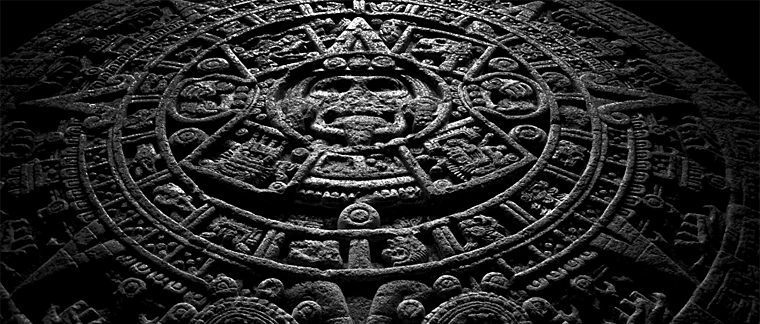
The world as we know it will end in 2012, or so says the Mayan calendar. Personally, I’ve not used the Mayan calendar for years; it’s too much trouble hauling around those massive stone structures aligned with cardinal points and keeping track of the shadows they cast. Moreover, I find human sacrifice unpalatable, as well as plucking feathers from various endangered species of birds. By comparison, my iPhone calendar is far too handy.

The inconvenience of the Mayan calendar aside, its so-called prediction is yet another in a long line of end-of-the-world prophesies that have been with us since human beings started waiting for the sun to rise. Early on, it was a solar eclipse that sent us reeling; an enormous dragon, we were told by FOX News (or its period equivalent) was consuming the sun! To satisfy the dragon, people must repent, and (by the way) make a generous material contribution to those who have influence on dragons.

Bible prophesy included the four horsemen of the apocalypse and beasts, and 144,000 souls lifted to heaven and goodness knows a big sloppy mess for everyone else to clean up.

In more modern times, Y2K was supposed to be the end of the world. You remember Y2K don’t you, the year 2000? This was the year when all the computers in the world were going to stop working at the stroke of midnight on December 31st, 1999. Trains would stop running, bank deposits would disappear, nuclear weapons would spontaneously ignite, cats would mate with dogs, Armageddon and an eternity of darkness would come upon us! Oops, never mind. Everything was just fine. How disappointing it all was, except for the people who make Twinkies (they say Twinkies have a shelf-life of 20,000 years!).

2012 is the latest entry into the end of times sweepstakes. If the predictions are right, none of us will be around to enjoy it. If they are wrong, we all must continue to pay our bills, which is a real bummer. Not having to pay our bills might well be the entire basis of these types of 2012 rumors, especially if the bills are taxes. “I’d rather be French-fried than pay my taxes,” one U.S. Senator was heard to say to a guy in the next stall of the men’s bathroom in the U.S. Capitol building; somebody told me this, and I believe him. Another pal o’ mine said the recent Tea-Party anti-tax, anti-government crusaders started the whole 2012 thing, which makes sense to me. Some people will do anything to avoid paying taxes. Hey, this whole recession is about avoiding taxes!

These end of the world fantasies are always a matter of marketing. If you look beneath the prediction, some idea is always for sale. It might be redemption, salvation, pay-back for bad behavior, alignment of the planets, unfortunate karma, pure chance or bad luck. No matter, as the end approaches we are all asked to believe one thing or another. What did one Brontosaurus say to another as the flaming asteroid approached earth 65 million years ago? “Don’t worry about paying your PG&E bill.”

Despite everyone else’s predictions, I happen to know exactly when the world will end. The world will end when I die, and I defy anyone to prove it to me otherwise.

The great spam war of the 21st century

Friday, January 8th, 2010

And so it was in 2009 that a brief hiatus, or rather a stalemate, befell the opposing sides. Despite the cascading billions of spam mail flooding the internet and swallowing vast terabytes of bandwidth – armies of drone zombie computers silently doing the bidding of distant masters scattered across the globe – Gmail and Thunderbird kept most of it at bay.

On any given morning, as email inboxes began receiving their daily flood of solicitations for Viagra, Cialis and various love potions, phony UPS delivery notices, inexpensive designer watches, pirated software, sly attempts to redirect traffic to malicious software, “phishing” expeditions, pretend newsletters and fraudulent notices from banks, communication supposedly from the FDIC, greeting cards from “family,” contest winner announcements, airline specials, communication credited to the IRS about refunds or unpaid taxes, regulated pharmaceuticals, and so on, just as quickly the spam filters shunted the flood into segregated “junk” and “spam” folders where their contents lay dormant and inactive.

As in any war, there were casualties, of course. In some cases, it was those sorry few who too old or vulnerable or inexperienced to fully understand the battle being waged would click on links within these spam mails and set loose the monster to feed on their own computer and join the ranks of zombies. And the web backbone itself, open to any and all emails legitimate or not, suffered as did the companies enlisted to support it. Routers and servers, jammed and pushed beyond their limits of delivery timed out, clogged and had to be re-booted. New equipment designed to handle greater capacity was mobilized, at great expense.

But the heart of the battle is not fought online, but in the mind of spam programmers. Even as the stalemate served to inoculate the population from the worst savagery of battle, plans were being drawn to escalate the conflict and break through the spam defenses. At one time, spam used phony company names, but now what seemed like individuals were the sender. As the filters became smarter, even this “personal” looking spam mail was detected and removed. For a short time image files fooled the filters, but this tactic did not succeed for long. A thrust here, and parry there, the duel continued.

And then, all of a sudden, the unthinkable occurred. The filters, having gained what could be called primitive intelligence, began to flood the spammers with their own spam mail. A pitched battle ensued in which the zombies and their masters found themselves on the receiving end of their own spam. A great circle of karmic retribution ensued, which though partly paralyzing the internet for months, finally revealed the identities of compromised machines and shut them down. A great silence cast a blanket of peace over the web.

Reports of email loneliness were reported on CNN. Despite the seeming inconvenience, spam had been of comfort to many, and nothing had yet arisen to replace it. So it was that “spamusic” arrived, a gentle symphony of pure sound selling nothing. This was followed quickly by “spart,” “spoetry” and “spamovels;” a huge burst of free creativity filled the vacuum on what had been the battlefield of spam war.

And so it remained until 2012, when dramatic global events changed web and world history forever.