Archive for November, 2009

One man’s junk – another man’s treasure

Thursday, November 26th, 2009

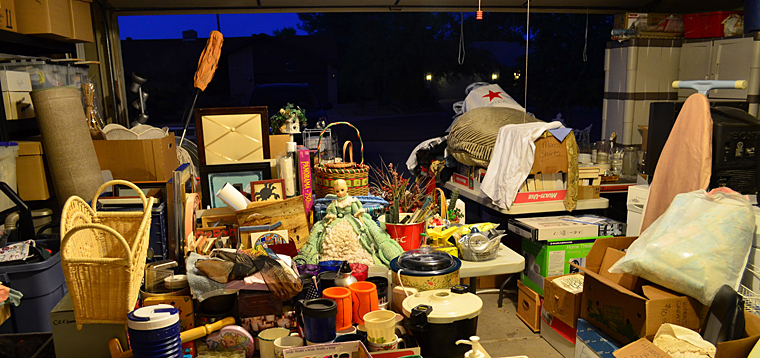
I usually don’t stop at garage sales; I’ve accumulated too much already. Nonetheless, I still find myself attracted to signs that say “estate sale” and this past weekend I impulsively pulled over to the curb and strolled into a back yard filled with boxes of stuff.

Actually, I’d be more accurate calling it boxes of junk. By late Sunday most everything had been thoroughly picked-over and what remained was just a hair’s breadth away from the dump. I wandered, wondering about the person that had collected so much. On the bottom of a chipped, handcrafted dark wooden bowl with a metal-covered flat raised center for cracking nuts it said, “Hand made in 1948 by M.D.” Who was M.D? Mike Duncan, Mitch Douglass, Monroe Dowd? I’ll never know. I tossed it back into a cardboard box filled with rusted bread and pie pans.

Inside the house, everything was tagged with a price. In one room was a collection of six massive mantle clocks, ornate faux-classical wood-carved timepieces with keyholes for winding priced from $45-$165. They all said “As Is.” It’s said even a broken clock is right twice a day, and I realized that if I collected 720 broken clocks, I could set the right time for every minute of the day. Ah, well.

One musty-smelling room was full of books, entire sets of encyclopedias and hardcover novels. I cracked open a volume that said “D” on the spine, and began to read about Delaware. The capital of Delaware is Dover, by the way. The photos were in black and white, and showed pictures of farms and cows. Not the Delaware I know.

I moved on into the garage, the space developed for the automobile but commonly transformed into a storage locker. From wall to wall, the garage was filled with tools. In one box were screwdrivers and other tools that had a similarity to screwdrivers. Chisels and awls were jumbled together with flat-heads, and Phillips – wood, plastic and metal-handled. Everything that could prod, poke or pierce had made it into this particular box.

Another carton held drills – the old-fashioned type requiring two hands and elbow grease. Some had over-sized wooden knobs at the top so a strong hand could get good purchase. There were all sizes, from modestly small to ridiculously large. In the day before electric drills, these tools were pure magic, transforming wood to curly-queues. Wait long enough and everything regains human value for a while. Tomorrow they might be “elegant knick-knack décor” hanging on the wall of a converted barn featured on HGTV.

There were boxes of pliers and all things that pinch – massive tin snips to tiny pairs of scissors – rotted cartons of screws and odd kitchen utensils; so on and so on, a massive collection, the accumulation of a life time. I thought about the magnificent obsession that drew all these tools together, and that many of them must have been acquired at other estate sales. Now, like their avid collector, all and everything was returning to the great undifferentiated source.

Of course, I too am obsessed. I bought two small stainless steel kitchen bowls and a ten-inch cast iron skillet for $5.40. When I got home I cleaned ‘em up real pretty, and used them to make lunch.

An epidemic of happiness?

Friday, November 20th, 2009

A recent article in the New York Times Magazine highlights the work of two social scientists named Nicholas Christakis and James Fowler, who have concluded that happiness is contagious. Unhappiness is contagious too, but 2% less contagious, it turns out.

The research used data from the historic multi-year Framingham Study on health initially focused on obesity and health-related habits, and found that both obesity and health habits appear in social clusters, or networks. People who decide to lose weight or give up smoking spread that behavior to others, who then spread it others yet again. In fact, the study showed that one individual actually affects the behaviors of friends of friends of friends before the effect dissipates.

Happiness follows the same pattern, and spreads contagiously to others. Overall, happiness spread at a rate of 9%, compared with unhappiness, which spread only at 7%. Thus, continued exposure to happiness accumulates over time and eliminates the contagion of unhappiness. Good news!

Other researchers are not entirely convinced. They are afraid that the factor of homophily, or the tendency of people to gather with others of their inclination has not been adequately factored into the statistics. Perhaps, they say, happiness does not spread virally, but happy people, for example, simply find and spend time with each other. The research continues.

That people are social animals is no surprise, nor is the fact they have influence on others. “Keeping up with the ‘Jones’s” is at the heart of advertising, after all, and were it not for Madison Avenue’s cynically manipulative techniques requiring incessant brain-numbing repetition, ads might more reliably tap into our desire to be like others. However, playing upon envy, pride and greed does not hold a candle to the influence of behavior or intentions of someone we truly enjoy as a friend. Media-scripted commercial “caring” is always phony while genuine friendship is reliably powerful and influential.

Of particular interest is the connectedness of behavior on those with whom those studied only had a third-degree association. Third-degree means a friend of a friend of a friend, as opposed to simply a friend (first degree). As behavioral attitudes are carried virally from person to person, such influence extends (at a lesser rate of “infection”) well beyond three-degrees of separation. Collective nodes of behaviors like happiness grow, becoming tangent to other growing nodes of happiness; the circle of viral contact increases. Taking cues from epidemiological studies, the researchers noted that over time nodes became “super-nodes” geometrically increasing and affecting enormous numbers of people.

If happiness is infectious, noted one author of the study, how we interact with members of our family has major impact. He now listens to upbeat music on his way home from work so that he brings an elevated mood into his house. Thus his happiness spreads among the members of his family, particularly his children. The contagion of obesity, alcohol and drug use, depression, and other forms of human suffering seem to follow the same patterns, with rates of contagion that vary. But nothing spreads as well as happiness.

Much as epigenetics explains how feelings and experiences influence the expression of genes, this study shows that how we each feel generates a field of intention that extends well past personal boundaries and ultimately affects people we don’t even know.

2009: A space oddity

Friday, November 13th, 2009

I’ve been spending time lately watching live and recorded transmissions from the International Space Station. Unlike the videos and transmissions of the past with poor image fidelity and sound, the quality of the current transmissions is fantastic. The color is great, the image clarity and focus are perfect, and the sound is clear and clean.

Traveling at 216 miles above the earth (1,140,480 feet) the station has had as many as 13 occupants, including the crew of the Space Shuttle. 216 miles seems so close, particularly when you consider distance on the ground. San Francisco and Los Angeles, for example, are more like 600 miles from each other. Yet at 216 miles from the surface of the earth, gravity creates orbital equilibrium against the centrifugal force of the station, speeding around the globe at over 17,000 miles per hour. Within the station, it’s all free-floating, not the least of which is human hair, prone to stand straight up it seems in the absence of gravity.

The conversations between station inhabitants and personnel on the ground are unfailingly polite, filled with “great job, thank you, exceptional work, professionally done” and other such superlatives. I suppose it’s a way to help insure that the space station crew feels appreciated and uplifted; a depressed space station crew makes for lousy conversation.

Watching the EVAs, (Extra Vehicular Activity, meaning working outside in space suits) are particularly interesting. From time to time, a camera view shows the earth as backdrop, moving quickly below the rotating station. 17,227 miles per hour is so fast that the station circles the globe in 91 minutes, and one gains a sense of that speed as Africa or Asia quickly slide out of view. Moving from hand-hold to hand-hold using grab bars installed on the outside surface of the station, the astronauts twirl and glide themselves in any direction, like acrobats or gymnasts of exceptional talent. There’s no net in space, no safety mats, no spotters. One big mistake and an astronaut can quickly become floating space debris.

NASA has its own cable TV channel, which I guess we’ve all helped finance. Personally, I’m fine with that. I like the idea of people living in space, floating the day away weightless, lighter than a feather. I like the idea of looking down on our planet, like a watchful parent minding a beloved child. I like that people of various nationalities live together in the station, and the presence of both men and women. In its way, like a home-made version of Star Trek, the space station presents us with the model human society: polite, virtuous, clean, industrious, non-discriminatory, multi-cultural, non-sexist, and courageous.

It’s too bad I’m the only one watching NASA TV; I’ve yet to find anyone else who enjoys seeing people live and work in outer space. On one level, it’s terribly boring. There’s no plot line, the projects include unscrewing and screwing many steel bolts, the space suits look clunky, the inside of the station is cluttered and gray, and there are no special effects. On the other hand, I keep reminding myself that these people are in outer space; floating, no atmosphere, outside temperatures of 250 degrees in the sun, and minus 250 degrees in the shade, unprotected from high energy cosmic rays, vulnerable to death in an instant. The most exciting real time, non-scripted reality show, ever!

The inconceivable lightness of being

Friday, November 6th, 2009

People think in words, but the world is not words. Language is an expedient method to describe reality using words in an attempt to communicate what we or others actually experience, but it never quite suffices. Life has an ineffable quality that’s hard to pin down. Try describing the color blue.

When it comes to animals, of course, human language is mostly useless. When we talk dogs bark and gesture, cats may or may not respond, and birds appear to care even less about what we have to say. Thus, the internal life of animals largely remains a great mystery. Some scientists claim animals don’t have feelings or emotional lives remotely of the sort people have and that, like programmed robots, animals behave solely through instinct, genetics and survival mechanisms. This narrow view has led to widespread animal experiments, many of them horribly cruel and damaging.

Others researchers believe that like people, animals have a full range of emotions and feelings including love, anger, loneliness, sympathy – in short internal lives of complexity and meaning. When Elephants Weep, the 1995 book by Jeffrey Masson, details a remarkably wide variety of documented animal behaviors that make sense only when viewed through the lens of emotional meaning.

Through empathy and attunement, people relate to others, associating what we observe and hear with our own personal experience. The solipsist avers that reality exists in mind alone; true or not, it’s certainly accurate to say that we cannot directly enter the mind and emotions of others. Yet, our empathetic nature deeply connects us to family, friends and society. Acts of altruism, compassion and bravery highlight our positive social narratives, while selfishness, greed and cowardice are viewed negatively.

It might be interesting to be truly omniscient, completely aware of the internal feelings and thoughts of others, but I suspect full understanding of our own inner life is job enough. Our internal lives are so often veiled and hidden from ourselves that maintaining insightful self-reflection is itself a rather prodigious accomplishment.

Life can be imponderable, sometimes a confusing and mysterious metaphysical mess. At such times, thinking does not solve it, nor talking or reading. The harder I try to impose a fixed reality, the quicker it slips through my psychological fingers. If my world changes from the inside how might I know it? Is it possible to step out of one’s own mind?

On some days I’m confident and assured, satisfied that the world is in order, and I along with it. As if I’ve finally mastered living, everything in its place and all my ducks in a row, I even begin to think I really know what’s going on. As I’ve grown older I’ve learned that such arrogance generally precedes a fall.

The truth of existence is inconceivable and inexpressible. Nothing we can say adequately describes it. We yearn to convey our experience of the inconceivable, doing so in words, art, dance and music. Though alone in our own intensely personal language of reality, in every instant we are the unobstructed moment-to-moment expression of the ineffable. Confused, we ironically seek to join the ineffable by attempting to confine and conceptualize it. Settling into this paradoxical realization one confronts the limits of doing. Open and relaxed, completely in the moment – not doing – one enters the inconceivable.