Archive for August, 2009

The dawn of ego

Friday, August 28th, 2009

The newly born infant enters the human realm pure of heart and mind. In the beginning all is one: no form, no feeling, no perception, no memory, no consciousness. Despite the varied manifestations and appearances of the world, for infants all sight, sound and feeling are the expression of one unconfined essence without name or distinction.

Immediately, feelings of good and bad, pleasant and unpleasant arise. Cries and simple quiet are the initial expression of these wordless feelings, and comfort and distress establish life’s first duality.
Within days, the visual and auditory objects of the world become attractive, stimulating or irritating, the five sense perceptions sharpen and early discriminating mind arises. A sound, a taste and a touch all become associated with feelings.

Shortly thereafter, memory begins, and with it anticipation. This is not the memory of thought but the memory of feelings and perception, the memory of the body and a characteristic of early formation of individual mind. This is memory born of desire, for it is desire that particularly marks the human realm.

Slowly the quality of one essence dissolves. As months slide by, feelings, perceptions and memories become associated with words. Things and experiences are identified, objectified and externalized in a process of continued individuation. Self-consciousness – a sense of self – suddenly arises, and with it the stirrings of ego are born.

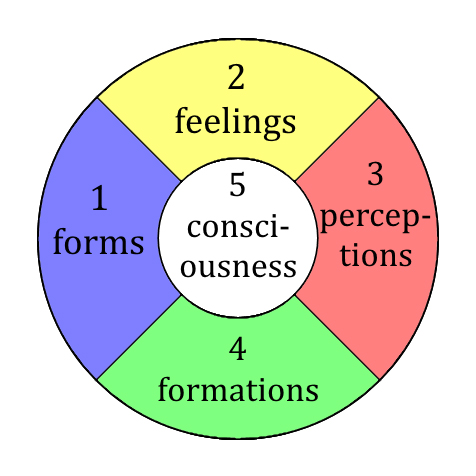
In Buddhism, these stages of ego development are called the “Five Skandhas” or “heaps;” a process of aggregation, an accumulation of experiences, sensations and thoughts that once gathered constitutes the formation and sustaining of ego. As is true in many of Buddhist teachings, the Skandhas are less a matter of dogma than objects of contemplation. In deeply contemplating each stage, a permanent, truly existing self cannot be found, allowing original mind to overcome ignorance and experience the pure essence buried under the layers of fixed concepts and discursive thoughts that distinguish ego-mind.

Our granddaughter Isabelle is only seventeen months old but already well along the path of ego-development. She does not fully understand the complexity of the world, of course, but she understands desire, the meaning of yes and the meaning of no. From here on in, her ego will continue to develop rapidly, though richly perfumed with ignorance. She will be told about “up” and “down” though our position on earth is more accurately “in” and “out.” In school she will be taught about straight lines, yet in reality no such straight lines exist. She will be called “good” and “bad” despite the fact that such judgments are relative, mostly a cultural matter of context and interpretation. Ignorance thoroughly permeates.

When she grows old enough, I will tell her about her true nature, which is unconfined and luminous – identical to the pure essence underlying all things. At first I suspect she will not understand, but if she cares for her grandfather in time she may become curious, reflect upon and contemplate this mystery. And as she grows older still, perhaps she will set aside ego’s ignorance-based hopes and fears, find each present moment of life precious and discover wisdom in kindness and compassion for others.

Like everyone, Isabelle carries the seed of awakened heart within her. To grow, it needs attention, love and care. I ask you, what else is a grandparent for?

On knowledge, generally

Friday, August 21st, 2009

We live in a time of specialization. Higher education for example, has primarily become a work-place on-ramp preparing top students to enter professional careers in which to specialize and make lots of money. Scholarship and acquiring knowledge for its own value has become secondary to obtaining the specific credentials necessary to get a high-paying job.

No matter what segment of the vast professional work force we examine, we find it filled with specialists who in many cases often cannot see the whole picture. Our current economic crisis is largely the result of financial world specialization. Creative “bundling” and “derivatives” specialists created vulnerable investment vehicles so complicated and obscure that virtually no one else could – or can as yet – fully sort them out. Lo and behold, the specialists created such a horribly tangled mess that the only ones we can rely on to straighten out the problem are…the very same specialists! This sorry fact does not help me sleep better at night.

Ironically, what we really need today are generalists, not specialists. I’m not saying there are not benefits derived from those who intensively study and master a particular discipline, to the contrary. However, I am saying that too many specialists often “miss the forest for the trees.” We live in a highly interdependent world wherein causes and effects radiate throughout the whole, not just parts. Accordingly, the decisions made by financial specialists have had broad effects on matters well outside of their area of expertise. The absence of a general understanding of the wholeness of our natural and man-made systems, the ability to grasp a larger view of decision making and choices based on a general appreciation of the big picture, has produced a persistent and pernicious form of professional myopia.

Our modern penchant to divide the world into discreet parts and ignore those in which we have no interest has led to a haphazard, disjointed and inefficient world, one where individual greed and self-interest have trumped building greater societal or ecological value. Specialization often breeds tunnel-vision, tunnel-vision blocks greater understanding and a lack of understanding underlies poor decision making. The unfortunate result is that we lurch from crisis to crisis, always trying to catch up with the unanticipated effects of what we have wrought through our specialized ignorance.

It’s hard to find a high-paying job as a generalist, I will admit, yet it is the one specialty we sorely need right now. Only the generalist, who by intelligence, intention and deep curiosity learns and masters diverse subjects and varied disciplines, can see the true wholeness of things. Leonardo da Vinci, Thomas Jefferson, Benjamin Franklin, R. Buckminster Fuller – to name a few – all generalists and benefactors of great measure. Through the generalist’s lens, all the myriad activities of humankind are seen to have a rightful place in planning and decision-making. Be it art, music, language, philosophy, science, medicine, law, cooking, farming, child-rearing, politics…you name it; in many subtle and not-so-subtle ways everything fits together to produce what we call our world.

Discerning interdependence inevitably leads to deeper understandings of how inextricably connected everything is to everything else; nothing occurs in isolation. The generalist understands, and with this comes the wisdom that what we seek for our own benefit must be of benefit to others. If not, eventually we all suffer.

Waterboarding: Enduring a tortuous debate

Saturday, August 15th, 2009

Slowly but surely the “torture” debate inches closer to full disclosure and accountability. In what is most assuredly one of the darkest chapters in modern American history, our immoral use of torture to wrest “confessions and information” from “enemy combatants” and other suspects held in Guantanamo and foreign countries is finally coming to light.

In documents released by the Obama administration, details of our torture program that were otherwise unclear have become much more discernable. Even the New York Times, which along with the rest of the mainstream media has mistakenly called waterboarding “simulated drowning” has recently changed its terminology and now calls it “near drowning.” Near suffocation is even more accurate, because that is what near drowning is; the deprivation of air due to the inhalation of water to the point of deliriousness and near-death.

I objected to the term “simulated drowning” in an article published in The Sun well over a year ago, calling it inaccurate, misleading and downright deceptive. “Near drowning” comes much closer, as it sharpens one’s understanding of exactly what is happening in this particular suffocation event. Try holding your breath beyond what feels comfortable, and then hold it for ten seconds more – feel your sense of urgency and panic rise. Hold your breath ten seconds more. This experience is mild when compared to suffocation by waterboarding.

Learning that one captive was subjected to this torture 83 times in one month is stunning news. Clearly this was not for the purpose of gaining intelligence or information; rather, this was cruel and unusual punishment, pure and simple.

There are those, like former Vice-President Dick Cheney, who argue that valuable information was revealed using torture, and we should not be so quick to condemn tactics like these. Only a man who has never served in the armed forces could make such a stupid comment. By rejecting the Geneva Accords dealing with the treatment of prisoners, the past administration gave the green light to other nations that torture. Such comments are more than ironic given the explicit statement by former President Bush that “America does not torture.” Sadly, we have placed ourselves in the company of the dark forces we ostensibly oppose. Through Cheney’s upside-down logic we become the very monster we abhor.

The current debate about bringing to justice the people who authorized torture has divided our nation yet again. President Obama seems to believe that such inquiry and prosecution will be too hurtful to America. Many Republican leaders staunchly defend the past administration, while condemning torture. Some Democrats prefer prosecutions in an effort to prove America is a land of justice and law. A “Truth” commission with no prosecutorial power has been proposed and rejected.

At the same time, a new batch of photographs showing the gross mistreatment of American-held prisoners will inevitably come to light. This will undoubtedly be shocking and disturbing, and serve to fuel the torture debate even more. At least everyone is on the same page now; no one denies that America tortured. We must honestly come to terms with that uncomfortable fact; it won’t be easy or fun, and not at all entertaining. Like any society that honestly examines and admits to its failures, it may serve, however, to better our nation in the end.

The Animate and the Inanimate

Sunday, August 9th, 2009

Entropy is the process of the orderly becoming less orderly, like water in a bowl slowly evaporates into vapor. The second law of thermodynamics posits entropy with determining the ultimate state of matter in the universe. As energy dissipates, the very structure of matter transforms through an entropic process; thus it is in time we all turn to dust, the stars run out of fuel, and the universe becomes a particle-filled darkness. Don’t worry…you have 50 billion years before that happens.

However, as living beings we display disentropy, accumulating and organizing matter and energy faster than entropy dissipates them. Consumed food, air and water combine to satisfy our need for cell function and replication. Living things, by definition, absorb and accumulate to sustain the life process. A mere three days without water are enough to bring our lives to an end. This is because the process of entropy is simultaneous with our disentropic activity, and can quickly overcome it during illness or incapacity. Like little whirlpools formed in water by the paddle of a canoe, our orderly existence remains only so long as the forces of disentropy are sustained.

These facts make us life-chauvinists. We have a natural bias towards life and living things. We love puppies and babies, and even recognize the energy and power of something as small as a mosquito. This bias also means that we often think less of non-living things. We throw our clothes on the floor, carelessly wipe mud off our shoes, kick rocks and add our garbage to the landfill. We may love one or another possession, like our car or easy-chair, but we think they are just “stuff.”

Notably, we are also made of stuff, stuff not all that different from the stuff we throw away. The basic elements and molecules of the living are essentially identical to the elements and molecules of the non-living. Moreover, much of the non-living once was alive. What differentiates the living is the disentropic process.

We think of movement – circulation within an organism and often the ability to move from one location to another – as the character of living things, an attribute of the animate We tend to view the non-living as inanimate. This view, however, is due to our temporal orientation; we simply do not live long enough to watch entropy turn rocks to dust. Given enough time, the sub-atomic forces holding molecules together change and give way; uranium turns to lead, after all. When existence is understood this way, birth and death are revealed as simultaneous.

Contemporary physics teaches that the inanimate is always moving; at the sub-atomic foundation of existence, the distinction between living and non-living disappear. The quantum realm is in continuous motion, simply a field of energy oscillating between non-zero values. So, the movement we generally associate with life is actually a property of both the animate and the inanimate.

Life utilizes energy and information in an observable and explicit manner. While lacking DNA or RNA, a non-living rock exists as energy and information as well. Though its energy dissipation is infinitely slow and the information consists of precisely ordered arrays of molecular structures, the inanimate rock is changing constantly, as are we. At the most subtle level, the animate and the inanimate are simply one and the same.

Nuclear Proliferation: Not leading by example

Tuesday, August 4th, 2009

As nuclear weapons technology has proliferated in non-western countries, Europe and the United States fulminate against authoritarian regimes viewed as a threat to peace and security. In some cases, like Pakistan, which is responsible for the spread of nuclear technology to the likes of North Korea, the West’s policies tread a thin line between reassurance and threat. Now that Islamic fundamentalists have set their own “surge” in motion, our past policy of support for Pakistan’s military control appears to mirror our misguided support of the Shah of Iran.

The West continues to believe that it can use sanctions and military threat to curb nuclear weapons development in other nations, this despite the complete failure of such policies. In past decades, India developed its own nuclear arsenal, violating every tenet of non-proliferation. Now that India has come under the sway of western-leaning politics, we have forgiven its trespasses and recently agreed to share nuclear technology.

Nuclear proliferation is a fact, and as long as such weapons are viewed as essential to national security, it will continue. With the world’s largest stockpile of nuclear weapons, the United States’ nuclear retaliatory capability remains the cornerstone of our ultimate defense and security strategy. Why then, one must ask, does the United States continue to profess shock that other countries with “unfavorable” and unfriendly leadership regimes assertively seek nuclear weapons development?

America has set the example and others are following it; it’s really not complicated. The possession of nuclear weapons is the ultimate “trump” card of military defense; despite the unthinkable risk of world-wide nuclear warfare due to accident or rogue state terrorism, these weapons of mass destruction are considered the greatest deterrent to war or attack. In one sense, they are, but only if it the threat to use them is believed. Thus, resoluteness, bellicosity and aggression must accompany the development of nuclear weapons, or such development is not credible. North Korea amply demonstrates this approach in its official declarations, weapons testing and missile firings.

America has forsworn the first use of nuclear weapons, but has not forsworn their use when under attack. Other countries which possess nuclear weapons include England, France, Germany, Russia, China, India, Pakistan, North Korea, and though not publicly admitted, Israel. Nuclear weapons are stealthily housed and transported in submarines, facilitating their use globally. It’s impossible to determine if a “nuke” has fallen into the hands of those outside of national jurisdictions; we can only hope not.

At this point, non-state nuclear threats seem more serious than state threats. When there is no clear enemy to deter or enemy location to threaten, the deterrent value of our nuclear arsenal is reduced to zero. Our efforts need to be focused on maintaining absolute security over weapons and fissile materials, insuring that these materials do not end up in the hands of non-state terrorist organizations.

Ultimately, unless the nuclear powers agree to jointly dismantle and destroy their nuclear weapons, proliferation and the risk of leaked technology will continue. With such an international effort, the development of nuclear weapons technology can over time be squelched. Without such a shift in policy, efforts to curb proliferation will continue to be viewed as hypocritical, self-protective, aggressive and, most importantly, will fail. This will stimulate the very proliferation we officially decry.