Archive for June, 2009

All gain – No pain

Saturday, June 27th, 2009

Americans have a short memory. When confronted by difficulties, we like to turn the page, move on, pull ourselves up by our bootstraps, get things behind us and not look back. The presence of so many commonplace ways of saying the same thing indicates how deeply our need to negate difficulty is embedded into our consciousness.

Such negation undoubtedly has short term survival value, but comes at the cost of repeating the very behaviors that get us into trouble. Our unwillingness to sit with difficult feelings speaks to our search for emotional equilibrium and stability, and forgetting our pain is one way we do that. The problem arises when that includes forgetting our own role in creating difficulties, and we then repeat our painful experiences over and over again. We seek to blame others, and often use aggressive means in doing so. Thus it is we plant new seeds of suffering which will take root, grow and bear fruit in the future.

In watching our economy, I see this proclivity already in operation. Despite the ongoing effects of deep recession, increasing job loss and continuing reduction of home values, the stock market keeps lurching around, like a drunk clumsily searching for change in a pile of dirty laundry. The incessant assault of advertising continues unabated, hour after hour of television commercials grinding their way into our benighted consciousness. Jeff Paul’s Short Cuts to Internet Millions, only $39.95, promises a new and better life, like those found by the average Joe’s in his infomercials who only last month were homeless but this week made $50,000. In the Jeff Paul infomercial world, the future is filled with busty blondes in strapless gowns eager to pump up deflated male egos and fawn over newly minted millionaires.

It’s not enough that legitimate and completely decent people are losing jobs and going out of business. Today’s climate brings out the very worst type of hucksters and snake oil salesmen, preying on the desperate, scared and unemployed and stripping them of whatever assets they might have remaining. And, it’s all perfectly legal.

My friend Alan searches for dishonest public companies that lie, cheat and steal for a living, commit fraud, release phony financials and employ high powered promotional techniques to seduce customers and skin them for all they’re worth. When he finds such a company, he sells their stock short, putting downward pressure on the stock price. This makes such companies furious, and they respond to this pressure by threatening to sue any and all investors who publicly question their motives or their ethics. Rule #1: The louder they threaten, the greater their crimes. In time their thievery is always revealed, and their stock price drops down the toilet. I’d like to think they go to jail, but in most cases they get a slap on the wrist and within a month or two are on to their next scam. Rule #2: Most stock crooks are serial offenders. Alan makes money by following them around and outing their slimy rackets.

There are those who forget that our current economic misery reflects the frantic behavior of American consumers who’ve spent far too much money for all the wrong reasons. The shameless scam artists remind us about greed, theirs and also our own.

For the sake of a good harvest

Monday, June 22nd, 2009

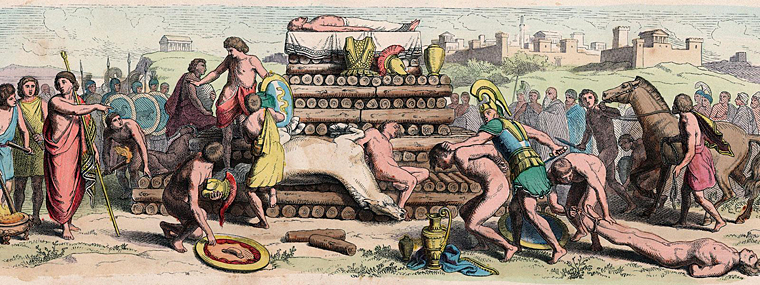
In their desperation for reliable food and sustenance some ancient peoples turned to human sacrifice. The shedding of blood was viewed as a way to satisfy the spirits or gods, who would then, they believed, provide food from the land. If a poor harvest ensued, caused by drought or heat, the assumption was made that the gods were unhappy, and people – including children – were sacrificed for the sake of a good harvest.

Today we view such behavior as primitive and cruel, the result of ignorance, superstition and fear. While we condemn such barbaric behavior, we simultaneously exalt our enlightened modern wisdom, considering ourselves to be civilized and humane.

Few of us grow our own food any more, and understand that it’s weather and soil, not gods, that grow food. Agriculture’s a business, one of the largest in existence, and a global market has brought us blueberries in December. Whatever harvest meant to people in the past, today it’s money we harvest, which we call profit.

The harvest of profit goes well beyond food. Virtually every segment of modern life has been monetized. Air, sunshine and space are almost all that remain free of charge. The love of money clouds ethical judgment and in our rush to find fortune great harm has been done. Among the worst harm is done to our children.

Cancer causing agents and hormone disrupters, BPA (Bisphenol A) and pthalates, are used in the manufacture of polycarbonate plastics, plastics used in baby bottles, formula and baby food containers. There is no more vulnerable population than babies, whose bodies and brains rapidly develop after birth. The European Union banned these chemicals in food packaging years ago, but in the United States their use has been widespread. Only now have the major manufacturers decided to stop selling such products in the U.S., though callously, they will continue to sell them in other countries.

Many of the tens of thousands of chemicals used in manufacture may pose risks to children. The effects of long-term exposure to these chemicals are unknown, because they have been introduced without long-term testing. Our regulatory system tends to deem these chemicals safe until proven otherwise, and such proof is found among its unwitting victims. Children and babies are the least capable of complaining and by the time danger is discovered, the damage is done. Asthma, diabetes, and auto-immune diseases are increasing in children; exposure to untested toxic chemicals certainly is suspect.

There are those who believe that government regulation is bad, that business should be self-regulated. The argument goes that the public should choose what it wants to purchase, and that caveat emptor (“let the buyer beware”) and free unfettered markets work best. If this is true, then it is just as true that the purveyors of products that harm babies and children are criminals, and they should be brought before trial. If the buyer must beware, then so must the seller.

Shopping for baby food for our granddaughter Isabelle, my daughter emailed me recently, “I cried standing in the baby food aisle while looking at the ten shelves of baby food in plastic #7 tubs.”

So it seems modern civilization has not changed very much after all. For the sake of a good harvest, sadly, we continue to sacrifice children.

The celebrity of nothing

Friday, June 12th, 2009

I have no Facebook page. I do not post tweets on Twitter. My cell phone number is a secret, and I don’t blog.

All this is true despite the fact that I have been in the website development business for 13 years and working with new technology is my daily occupation.I help my clients with all of the above, and even recommend how to work with new technologies in the most efficient and effective ways. Just as I can teach my friend Stanley how to make meatloaf despite the fact that I’m vegetarian, my understanding of new technology does not mean I need personally consume it. Though privacy is disappearing and being seen by 10,000 “friends” has become a world-wide obsession, I believe that anonymity will soon be the new celebrity.

The 60s pop art artist Andy Warhol was clearly wrong; he said everyone would have “fifteen minutes of fame,” but it turns out it’s only fifteen seconds. Actually, with two-hundred million people on Facebook, uncountable millions of daily blog postings and never-ending minute by minute Tweets, even fifteen seconds may be too much. In short measure, fifteen milliseconds will be the average.

The avalanche of online communication represents an all new phase of human evolution. The opinion of strangers now outweighs all paid advertising, and online viral marketing is quickly supplanting traditional media campaigns. Newspapers, the past’s great leap forward in mass communication – dependent upon traditional advertising for profits – are folding all across America. The web’s rumor and opinion mill moves far faster than a printing press, and the iPhone and BlackBerry have morphed into powerful mobile mini-desktop computers.

When I Google myself, I see thousands of results, online testament to twelve years in public office and my name in digital print. Soon everyone will fill the Google index with entire lifetimes of data, a vast repository of daily minutia extending from one’s toothpaste preference to bowel habits. In some strange way this might prove useful from an anthropological data-mining perspective, but I must confess that on a personal level I find it a great bore.

It’s been said that in the past people lived lives “of quiet desperation” and I suppose the web’s incessant chatter simply reflects today’s lives “of noisy desperation.” Indeed, there is a desperate quality to obsessive Tweets and blogs and Facebook pages, as if documentation of living is a substitute for life itself. I suppose that if, as it is for some, such online life is constant, then it truly has become life – life as a record of itself as a record.In time then, the great curiosity will be the anonymous undocumented life, a life lived invisibly. This will be a monumental non-achievement that must by necessity be unnoticed and not acclaimed; a life outside of life – an existence that cannot be proven – an art form all its own. Like colorless paint on a blank canvas, such expression will not be understood because there will be nothing to understand – the celebrity of emptiness.

When we are gone only memories remain, and in time those too will fade. Perhaps the fevered online world, then, is actually about our age-old pretensions of immortality. For assuming that the Google world lives on, dear ones, the blog post will live forever.

The metaphysics of the ordinary

Saturday, June 6th, 2009

Our uniquely human existence is both physical and metaphysical. The physical includes matters such as eating and sleeping, cutting the grass and driving a car. The metaphysical is no doing, but thinking about eating, sleeping, cutting the grass and driving a car. If we examine our everyday existence, we can see that this combination of imagining and doing is the way we interact with the world.

We can intuitively and naturally interact with the natural world as events happen around us, an ability that does not require thinking and which is of the nature of a first-order level of experience. The time we spend thinking about what goes on around us is a second-order experience. There is little evidence that most animals other than humans think this way. Most animals seem to operate at the first level order of experience, which is to say they react to input, and while habit structures can form associated with food for example, it is unlikely that animals think about why food has or has not arrived.

Thinking, of course, requires a language of thought, a second-order abstraction of the first order direct experience. Without words, we cannot form thoughts. Emotions can form without thinking, of course, and in that sense raw emotions are closer to a first order experience than our thoughts. When we react to our thoughts about our feelings, we are becoming even more removed from the first and second order experience, and generating a third-order experience of emotional reactions to our own thoughts. Step by step, we spend increasing amounts of time in this third-order experience, an entirely metaphysical world of our own making. It is in this third-order world that matters of blame, projection of intentions, jealousy and envy arise as we build complex multi-layered thought-reactions to reactions.

The third-order metaphysical world is also where complex planning and predictions take place. We use our reactions to our ideas and thoughts in order to judge them. Anticipation of the future based upon assumptions and probabilities allows us to send probes to Jupiter, plan foreign policy and operate a business. Our metaphysical world can be laid over the physical world in a highly workable way, accordingly allowing us to use imagination to transform and bend physical reality to our liking. So powerful are they, we can even mistake our own thoughts for first-order experience itself. The world of the paranoid psychopath is frightening real.

An absence of making time to rest with a first order experience – listening to the rain, feeling the spring breeze, watching children at play – deprives us of appreciation of the physical world upon which our metaphysical world sits. Without a regular opportunity for grounding within basic awareness, we can easily become lost in our metaphysical world of thought, and even begin to invest it with greater import than what is actually happening around us. When this happens, we stop paying attention and are prone to confusion; our metaphysical world is only as well ordered as we are, and one glance at human society reveals the great depth of our disorder. We fight and wage war based upon our metaphysics.

The physical world can be dangerous and may cause injury, but it never hates and never tortures. On the other hand, neither does it love.

A note from Mommy

Wednesday, June 3rd, 2009

A long time ago when things got too tough, I’d get a note from my mommy. I appreciated my mother’s understanding that I needed a break every once in a while, and that she was on my side. “Please excuse Larry from PE today. He has had a sore throat and needs to avoid getting overheated.” Tormented by my sadistic gym teacher, Mr. “D,” such a note brought blessed, albeit temporary relief. On the other hand, “Please excuse Larry from today’s spelling test today. He threw-up last night and we sent him to bed with no time to study,” was a predictable flop; I was sent to the nurse’s office instead.

Like most of us, from time to time I get frustrated and take it out on the world; sometimes that means I’m not nice enough to my wife. I get sarcastic or bossy, critical or impatient. Upon reflection, I realize I’ve been a jerk. I apologize, of course, and make amends, but it’s at moments like these I wish I could still get a note from my mommy.

It would read something like this: “Dear Norma: Please excuse my son Larry for his recent unpleasant behavior. He’s been under a lot of stress lately, working too hard and not feeling himself. I know he feels badly about what he’s done, and is making a real effort to be sure it doesn’t happen again. Thanks for understanding. – Sincerely, Larry’s Mommy.”

Alas, in adult life, there’s no one to make up our excuses. Left to fend for ourselves in a sometimes difficult world, we must confront the consequences of our own choices and behavior. Imagine how nice it would be to send a note like this: “Dear IRS: Please excuse Larry from paying taxes this year. He’s a hard worker, but the economy stinks and he just was not able to come up with the money. I know he’ll do better next year. He’s a good boy…really! – Thanks, Larry’s Mommy.”

When it comes down to it, everyone should be able to submit a small number of excuse notes per year. I think this is a basic right and should be added to the U.S. Constitution: “Life, Liberty, the Pursuit of Happiness, and Two Notes from Mommy.” Call it the 2009 “cuttin’ some slack” amendment. Life is hard, after all, and everyone needs to be cut some slack every once in a while.

I’ve decided to create NoteFromMommy.com, where people can download excuse notes online. There will be categories to choose from, like “Bad Behavior, Late Payments, Hung Over” and “Caught Speeding.” Users will be able to create new categories, too, as circumstances require, like “Yelp Insults” and “Inadvertently Deleted Email.” And the accumulated demographic data will contribute to national statistics on “slack” providing a basis for identifying trends of transgression. Over time, dissertations will be written and doctoral degrees will be earned. Best-selling books on excuses will be published. Social networks will build, support and self-help groups will proliferate, and a cabinet-level Department of Excuses and Forgiveness will dole out funds and generate many new high-paying jobs. Or, not.

Maybe I won’t get to any of this; I have kind of a sniffle and feel a bit tired. What I really want right now is my mommy.