Archive for March, 2009

Love letters and nasty notes

Saturday, March 28th, 2009

I receive a fair number of reader comments about my columns, mostly appreciative, and occasionally not. While notes of appreciation are a pleasure to receive and easy to respond to, nasty notes are a challenge.

During my twelve years in public office, I learned to roll with the punches. After a few unsettled years of pride, jousting and defensiveness, I finally came to realize that people need a safety valve for their intense feelings, and that local politicians fill that slot perfectly. Over time, whether comments were complimentary or derogative, I understood that simply sitting down to hear them was part of the job, and my agitation settled down.

The sorts of comments people make in public are different than those sent by email. Public comments are usually tempered by the setting, and over the years, very few people said anything overtly insulting or downright mean. This is not the case with email. Lacking the constraint of public exposure, some people send angry emails filled with insults, invective and, dare I say, hate. Despite my past years of public service, I’m still subject to shock.

I received one such email from a fellow the other day. Derision followed insult, accusation was piled on complaint. His tone was angry, dismissive and self-righteous, and I honestly could not decide how to respond. It’s not that I couldn’t think of an answer, I just didn’t feel good about any of them.

The easy answer, of course, was to shoot back in kind. The email was full of spelling and grammatical errors, an easy opening for comments about low intelligence and lack of education, but that seemed mean spirited to me, a cheap shot, and guaranteed to fan the flames of anger.

Another was to be ironic; inquire whether the email was a disguised attempt to open dialogue, and why the writer thought insult was an effective way to establish communication. That option felt patronizing, and snide.

I considered sending what sounded like a form letter response, something like, “Thank you for your note about my recent column. It’s readers like you who make it all worthwhile.” But that was too cute and dishonest, too.

I thought about suggesting lunch or coffee. Since the writer’s never met me perhaps he might discover I’m not such a bad sort, after all. On the other hand, did I really want to risk sharing steaming hot coffee with someone so angry at strangers?

After contemplating the situation for days, I realized that it was difficult for me to make a decision because I was uncertain of my motivation. I rejected revenge and all that flows from it. I tried desperately to summon compassion for someone so filled with anger, imagining his daily torment, but it felt intellectual, and not genuine. Did I really want to understand why someone would belittle me, or was I just hoping to feel better?

I concluded that all I could rely on were my feelings; my rational self was altogether unqualified to craft an answer. Too often I shy away from difficult emotions, and instead resort to dry intellect. So finally I just replied with the simple honest truth: 

“Dear Reader:
Your angry and insulting note was quite upsetting and left me feeling lousy for a few days.
Sincerely, L. Barnett.”

The joys of tea

Saturday, March 21st, 2009

Over the past several years I have become enormously fond of drinking tea. My father used to drink tea each morning, and I remember as a boy joining him at breakfast with a cup. I didn’t really enjoy the tea, but I enjoyed sitting with him sipping Lipton’s and feeling grown up.

My mother discouraged soda drinking and all we had around the house was Canada Dry Ginger Ale and Quinine water. To my boyhood palate, neither was tasty and by young adulthood, soda held no interest for me at all. Lucky me.

My tea drinking days ended when left home at eighteen and I rarely if ever drank tea. As the 60’s and 70’s arrived, chamomile tea became popular, as did a number of strange herbal teas. Lipton’s was banished along with the rest of the “never trust anyone over 30” accoutrements. 
 
I never particularly liked coffee, and heavy caffeine does not agree with me at all. In short, my beverage of choice has most always been ordinary plain cold water. Some people I know can drink liquids just short of boiling; I don’t know how they do it. I have burned my tongue so many times I’ve lost count. Does the tongue get calloused? Someone must explain to me how to avoid burning my tongue while drinking boiling liquids. If you have insight on this, please let me know.

In any event, as I entered my fifties, I began to drink tea again – not boiling hot tea, but pleasantly hot tea. I began with green tea, and progressively found one favorite after another; gunpowder green, Japanese sencha and matcha, green and white blends. We must have 20 different boxes of tea in the pantry by now. But my absolute current favorite is a tea picked by trained monkeys.

Monkey Tea, as it is called, comes from China and in broken English the can says that the tea is grown on hillsides so steep that the delicate leaves can only be picked by trained monkeys. The front of the can features an illustration of an attractive white monkey with a long tail hanging from a branch by one hand, stuffing leaves with his other hand into a leather pouch hanging from a strap around his neck. He looks happy but well focused, and the research I’ve done on the web about this these monkeys says they are treated like members of the family. Given how some members of the family are treated, this does not entirely reassure me, but all this is happening on the other side of the world, so I choose to believe that the families are sweet and lovely. Some websites say the whole story is sheer baloney, but the web is filled with cynics.

The tea itself is an Oolong variety, very dark and smoky with a complex finish. It has a slight tannic bitterness which I find rather pleasing.

When I mention my Monkey Tea to my tea drinking friends they don’t believe me, so I show them the can. That stops them a bit, but then the comments about where monkeys scratch begin. I concede that highly trained and loved though they are, these tea picking monkeys most probably don’t wash their hands every time they scratch, but frankly, I prefer not to think about it.

Playing the fool

Friday, March 13th, 2009

Wall Street brokers commonly refer to market theory, a high-sounding pseudo-scientific set of investment principles developed to explain and predict how markets work. Between themselves, the brokerage community refers to yet again another valued theory, but this one is called “the bigger fool” theory. Simply put, the bigger fool theory was articulated perfectly by 30s comedian Sidney Fields: “There’s a sucker born every day.”

For every winner on Wall Street you can find a loser. In fact, without losers, there can be no winners. Wall Street is a betting game; money is plunked down on the table and the winners take it all. Of course, the house always takes its cut, and brokers make commissions no matter what happens, win or lose.

Raising capital through public markets is a lynchpin of capitalism. Companies offering stock or bonds use markets to access funds made available by institutions and individual investors. Unfortunately, it is the individual investor that usually gets screwed and played for the bigger fool. This is not to say that all companies that sell stock are crooks, but it is fair to say that the markets are squewed in favor of the biggest institutional investors and when it comes to market manipulation, the little guy doesn’t have a chance; the game is rigged. Brokers and traders collude, conspire and manipulate prices every day. Tens of millions of trades are made daily; in a global marketplace, this happens 24 hours a day. The financial market is a global casino, and market theory is just an attempt to place a gloss of legitimacy on an opaque and complex gambling operation designed to fleece the public.

When Bernie Maddoff comes along and spends 30 years skinning his friends and their friends of their hard-earned cash, investors wring their hands in anguish and cry, “How this is possible? Where was the SEC?” When it comes to Wall Street gambling, the SEC (Securities Exchange Commission) is lined up with the house. Former members of the SEC end up with top paying jobs at the very firms they used to “regulate,” a sure sign that the game is fixed. And at its best, the SEC can only track the biggest players with the most on the table. The individual investors have nobody in their corner.

One may ask how all this came to pass. The answer can be found in the nature of large systems. Any large system ultimately functions to preserve and enhance the power and authority of those who benefit from that system; it is simply the nature of institutional systems. Thus, the markets actually fulfill their mission perfectly. Despite appearances and conventional wisdom to the contrary, it is not the purpose of the market to spread wealth, maintain financial order, provide access to capital, or support the economy. The purpose of the market is to insure that the wealthiest gain greater wealth, and that the powerful gain greater power.

Like many, my wife and I have lost a large part of what funds we have accumulated over the past 35 years together. We are not bad off, to be sure, but we’ll both be working hard for the foreseeable future. I thought I had learned my lesson in the 80s, but now I realize I did not learn it well enough. Turns out I am the bigger fool.

A slice of time saves dimes

Friday, March 6th, 2009

It’s said that time is money, but until a recent discussion with an airline seatmate I’d not realized how far this idea has gone.

I’ve been flying back to NYC to visit with my parents fairly often this past year, and about 25% of the time, I chat with my seatmates. This last trip was particularly interesting; sitting at the window was a young man from India, and as he pulled out his laptop I asked him what type of work he does.

Turns out he is a programmer and information systems architecture designer, with a specialty in the financial world. He had done some work for banks in the past, but had launched his own business recently specializing in the development of faster technologies for securities trading.

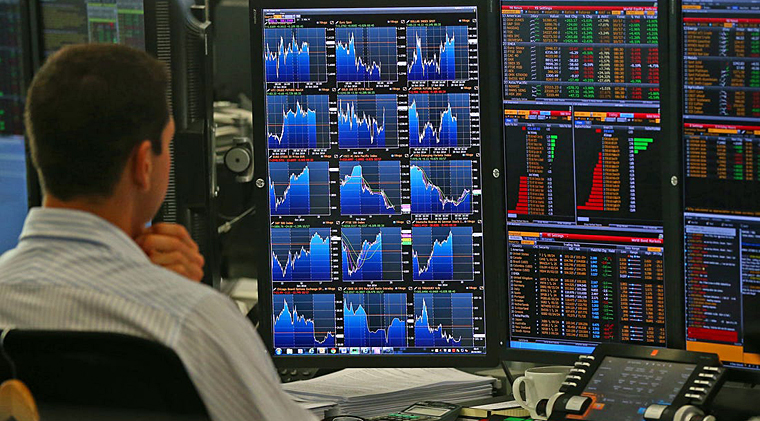
The global securities market never sleeps and never stops trading. Billions are made speculating on overnight currency fluctuations, international hedge funds, indexed market movements and other such arcane and impossibly complex trading activities. Moreover, most of this trading activity is computer generated and controlled. Highly complex computer programs initiate and consummate trades in the many billions of dollars, all without the participation of human decision making. Humans think and act far too slowly to take advantage of what has become an endless tsunami of speculative trading activity worldwide.

The problem now, it seems, is that today’s computers and the existing trading systems are too slow to satisfy the greed of the market. When $100 billion changes hands amidst fluctuating price oscillations, executing a trade at a precise moment in time can generate profits or losses of millions of dollars. Milliseconds (thousandths of a second) are not fast enough anymore; a delay of milliseconds can erode profit.
 
So the problem my new friend was working on was one of slicing the moment of “now” into even smaller slices than are possible today. “Now” is a moment, but we cannot define it precisely. We can coordinate our clocks using the oscillations of atomic nuclei to coordinate time, and all agree that noon is noon. However, in the reductionist and materialist view, even “now” has duration; a beginning, a middle and an end. Therefore, it is reasoned, if one can execute a trade closer to the beginning of “now” than to the end, one can slice the market value of time thinner, for a profit.

We both agreed that this materialist approach to time was insane, but my new friend was so intrigued by the challenge placed before him (and for which he flies to NYC every two weeks to meet with those who have engaged him) that he found it irresistible. Even the beginning of “now” has a beginning, middle and end, we agreed, and therefore the process of slicing time into smaller and smaller bits can never reach a conclusion. But for those infected with madness for money, such philosophical contemplation means little; he who slices time smaller stands to gain an infinitesimal, yet calculable advantage over others. In the world of profit and loss such an advantage is worth billions.

I opened my book and he went back to his keyboard and algorithms. And somewhere in New York, a financial services company executive was leaning back in his chair, dreaming of beating his competition to the global betting window by one-tenth of a millisecond.