Archive for January, 2009

Time, nowness and attention

Friday, January 30th, 2009

Einstein’s General and Special Theories of Relativity put an end to the notion of absolute time. His formulations and subsequent scientific experiments confirm the plasticity of time, and demonstrate that depending upon velocity, direction, and position of the observer time is not the same at every point in space.

In our ordinary everyday world we all move in tandem and share an inertial frame of reference. This is to say that our clocks all run at the same speed and that a second in Paris is as long as a second in New York. Should one of us be able to escape this frame of reference and attain near light speed, that would change, but since we cannot seem to even get a fast bullet train to Los Angeles from San Francisco, it’s unlikely any of us face that prospect.

Our perception of time is that it has direction, moving from the past, through the present and forward into the future. While we might like to run time in the opposite direction, particularly when it comes to today’s stock market, it’s not possible for us. We are irrevocably, it seems, carried along by the arrow of time, growing older each day and accumulating memories of the past.

An argument can be made that there actually is no such thing as the present. My friend Steve Bhaerman, aka Swami Beyondananda, opens his cosmic comedy act by asking “How many people in the audience want to be more in the now?” When hands go up, he quickly yells, “Too late!” Everybody laughs, but it is laughter born of an uncomfortable paradox – that the present lasts only long enough for the future to become the past. The present, for all intents and purposes, is nothing but change, and its impermanent nature makes it impossible to pin down.
 
Spending time solely in past recollection or future fantasy eludes the art of appreciating the eternally changing moment in which we actually live. Here again, we encounter the paradox, that the present exists solely as a function of our attention. The desire and attempt to arrest time is akin to the act of grasping for smoke, we can envision the moment we want to hold only in our minds; a fading mirage, it no longer exists. Thus our fixations, mental and emotional habits distract our attention from the ever-changing moment of being.

It’s difficult to rest comfortably in a timeless space balancing on the edge of past and future. It feels groundless, confusingly ephemeral, and even frightening – no wonder we like movies. Yet this momentary transitional point is precisely where and when we always are, and despite plans or regrets, it is all we have or have ever had to work with. In the infinitesimal moment of impermanent transition we have choices; about things to accept and to reject, to say and to withhold, to do and not to do. Our actions have definite consequences, and we cannot reverse time, after all. In attention to the moment, we can let go of hopes and fears and simply do what needs to be done. Each moment presents an opportunity to start afresh should we so choose.

It is in this way that our world is created and that the paradox of time dissolves.

Depression jobs in abundance

Friday, January 23rd, 2009

Over recent breakfast with the boys, discussion turned to economic depression – what each of us might do for a living if worst comes to worst. Some of the great strengths of human beings are resourcefulness and creativity, without which we would never have scrabbled ourselves out of the savannah and invented the Chevy Nova.

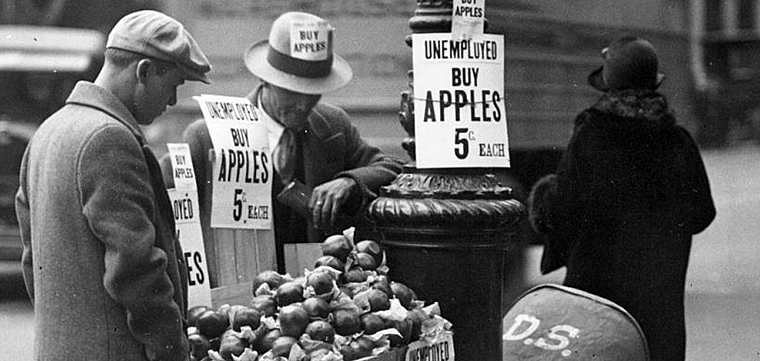
When the economy is strong and many jobs are available, our creativity is often put to rest. We find out what other people are offering, and shop for jobs like we shop for apples. When we find one that looks good, we choose it. When the economy is weak and few jobs are available, our creativity is heightened; if not, we succumb to mental depression and visions of Hooverville. So keeping an upbeat attitude is not just half the battle, it’s the whole she-bang.

Our Friday morning, post-yoga breakfast group consists of aging men who love to talk, but not about sports or cars. This group, as a proper post-yoga group would, talks metaphysics, personality disorders, recent surgeries, the benefits and liabilities of bacon, the humor of tragedy and – based on the jokes that are told – the tragedy of humor.

As to the depression survival occupations, they flowed forth in abundance. “Dumpster diving for pizzas outside Pizza Shack,” said Michael. “Growing bean sprouts, the super health food,” said Scott. “Lead a chorus,” Mark added wryly. “Writing financial bail-out applications,” offered George. “I plan to be a beggar, and pray,” Ed said, his head bowing. “I’m off to the Jungle and be naked,” Mike pronounced. I suggested, “Selling roasted chestnuts and pretzels from a pushcart.” Last was Ira; “I already have my depression job,” he said solemnly, “I teach school in Vallejo.”

Everybody – all of us – have things we know and things we can do. Some cook, some know how to plant a vegetable garden. Others can fix a motor, build a table, wire a lamp, make a birdhouse, climb trees, whistle, recite poetry from memory, train dogs, predict the weather and so forth. Some of these things are useful for pre-depression jobs, but in a depression, everything we people do forms the deep pool of human talent that overcomes famine, war and disease. As the monetary system shifts and the value of money plummets, it’s human talent that always saves the day and rescues humanity from the grip of disaster. Except, that is, on Seinfeld.

Money, after all, is just a token for objects and activities. It has no intrinsic existence of its own, which is why is has any value at all. As a token, it can be used for anything, and thereby assume any form. This magical quality has made money modern culture’s biggest celebrity. We think nothing of throwing away a dollar’s worth of leftovers, but would never throw away a dollar bill. This is because we know that leftovers are just leftovers, but a dollar bill can be anything.

In a depression economy, talents and a positive attitude matter far more than money, and there’s always trade and barter. The talents don’t have to be extraordinary, because we simply need what others can do and others need what we can do. Our common humanity becomes more obvious, our dependence on each other more plain, and our choices far less confusing.

The Breath of the World

Friday, January 16th, 2009

Go ahead and take a breath, dear one,
The earth is generous. Besides,
You will give it back, soon.

Breathing is so constant and continuous that it’s easy to forget about it. In fact, if we could not forget about it, life as we know it would be nearly impossible. Regulated by the autonomous nervous system, breathing is involuntary, and requires no forethought or active mental management; the internal chemical messengers of our bodies and brain-stem do not require the assistance of conceptual mind.

At an average of 10 breaths per minute, each of us completes over 14,000 breaths each day, five million plus each year. Rarely do we notice them, except when some form of physical exertion stimulates heavy or rapid breathing, or if our breathing is obstructed by asthma or a debilitative lung disease. Some breaths are short and others long. Some deep, some shallow. This is all quite automatic.

There are, of course, activities in which attention to the breath is intentional – blowing out a candle, for instance, or clearing the lungs of some obstruction by coughing. And there are meditation techniques which use close attention to the breath as a way to focus the mind and induce a state of equipoise.

We are joined in breathing air by every other land-living animal, all of which employ one method or another of bringing life-giving oxygen to our cells. Not all animals have lungs, of course, like insects, but once an animal reaches a particular size its life process requires lungs and breathing. If breathing stops, life stops. The simplicity of this situation seems so obvious that one might wonder why it’s worth writing about.

Well here it is: Sometimes I wonder – is it I who breathes the world, or the world that breathes me? While simply stated, this is actually an impossible question to answer. I cannot suspend my breathing voluntarily for very long. I can hold my breath, but at some point I must breathe again. Breathing is an absolute imperative, inseparable from life itself and nearly simultaneous with birth. I do have some control over breathing, but it’s limited and proscribed by a pre-determined set of instructions that are hard-wired into my brain and body. I am at the mercy of the world, thrust out of the womb and forced to breathe and breathe again for the rest of my natural life.

Sometimes I purposefully set aside some time and imagine each breath I take is the exhalation of the world entering me, and that my exhalation is drawn out of me by the world’s inhalation. In surrendering my sense of agency, this inverted symmetry carries with it sensations of both liberation and connection; liberation from the persistent illusion of being the sole and independent agent of my life, and a deepening of my connection with the phenomenal world outside myself.

As the ocean laps earth’s shores, and has for untold millions of years – rushing in and drawing out, giving and receiving – so too has the airy world animated its moving breath through living things. In the hurriedness of life, we sometimes forget that we are inseparable from something very large, very old and continuous. Breath reminds us.

All the wrong places

Sunday, January 11th, 2009

I recently enjoyed my five-year colonoscopy. OK, enjoyed is not the correct term; endured is more like it.

Five years ago, I had to drink what seemed like a bathtub’s worth of putrid liquid, but they’ve made great progress. This time I only had to drink half a bathtub, and the flavor was lemon-lime, not unlike my memory of 7-Up, which I have not tasted since I got the measles at 16 and couldn’t eat solid food. Sorry, 7-Up.

I strategically stationed myself no more than ten feet from the bathroom, and wore my short samurai-style bathrobe and nothing else. To call the effect of “HalfLightly” dramatic does not even come close. We are talking about bathroom Olympics here, where speed, control and agility are essential. The only other choice is to grab a good book, sit down and simply never get up for six hours.

The next morning I arrived at the hospital at 6:45 A.M., was admitted and taken to a room where I placed my belongings in a plastic bag and donned the archetypal hospital gown that’s open in the back. “How convenient,” I wryly commented to myself. A grandmotherly nurse inserted the IV line and I was wheeled off to the colonoscopy palace. As I rolled in, a fellow-traveler rolled out looking totally spent, like he’d just endured having a nine-foot long camera snaked up his colon.

“Good morning!” said my doctor, Steven Steady, chipper and happily going about his business at an ungodly hour. You’ve got to like a doctor named Steady who performs colonoscopies. Imagine how it would feel to have doctor Wiggly, Jerky or Rough! We bantered for a while about death and other cheery topics and then I was whisked into the inner sanctum. “Can I get a CD to show my friends and family?” I asked. “Hahaha,” everybody laughed. Hey – I was serious!

Last time I tried to be the macho tough guy using no anesthetic; I lasted thirty seconds. This time I had no illusions, and told them to put me under. “Feel anything yet,” the nurse asked. “Nope,” I replied, “not…”. That’s as far as I got. Next thing I knew I was waking up and somebody was talking to me but I did not really hear them and was I really awake or just dreaming and then my clothes were on and I was handed a photo and somebody said something and Stanley drove me home and I don’t really remember any of that too well, as you can tell. My wife later told me they administer an amnesia drug, and given what happens in that colonoscopy room, I think it’s good I don’t remember.

Dr. Steady removed four small polyps this time, three the last; I seem to have talent in growing polyps. For those of you who are over 50, it’s time to join the club – seriously. Colon cancer is a leading cause of death, and caught early, is very treatable. The absolutely best treatment is to remove any type of precancerous growth, like polyps. I can’t say a colonoscopy is fun, but overall it’s tolerable, and well…I got a column out of it.

The domino effect revisted

Friday, January 2nd, 2009

My daughter and her husband are on their honeymoon. They didn’t go to Paris or to London or to Rio de Janeiro. They went to Vietnam.

For those of you too young to remember, Vietnam is the place that many liken to America’s only lost war and greatest military humiliation. As evidenced in the Pentagon Papers released to the public by former Marine turned Rand Consultant turned war critic Daniel Ellsberg, such fears of humiliation fed increasingly greater military involvement beginning with Presidents Harry Truman in the early 1950s to Richard Nixon in the middle 1970s. They and all the presidents in between knew that the war in Vietnam could not be won and that the majority of Vietnamese supported independence from Western powers, but fear of humiliation was so strong that over 50,000 American soldier’s lives were lost, along with hundreds of thousands of Vietnamese lives.

Fear of humiliation was cloaked in arguments about “The Domino Effect,” that defeat in Vietnam would result in the Communist domination of the entirety of Southeast Asia. This point of view so overwhelmed public discourse that it became the conventional wisdom of the day, and such logic is still used to justify American military adventures no matter how ill conceived and poorly supported they may be.

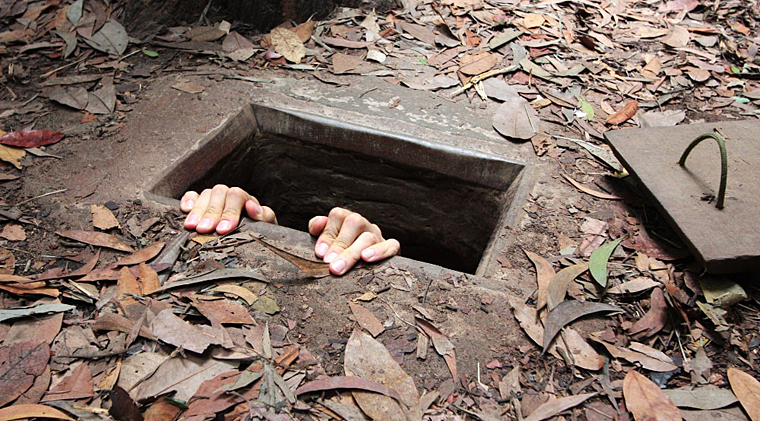
So it is with some great sense of irony that in her email to us our tourist daughter recounts their visit to underground caves and tunnels which once housed and provided sanctuary to members of the North Vietnamese army; their eco-lodge weekend at the border of China in what used to be North Vietnam and the home-cooked dinner they shared with the family of a woman they met in Hanoi. Born in 1971 as the Vietnam war was drawing to a close (meaning American’s scrambling to board helicopters from the rooftops of buildings in Saigon, now Ho Chi Min City), our daughter carries none of the dark memories of those of us who lived our youths in the gloomy shadow of that war.
 
Vietnam, of course, has a history that goes back for thousands of years. The Western colonial period occupies just a small slice of its history of foreign domination, which includes 1,000 years of Chinese rule. However, I cannot help but be struck by her choice of honeymoon location, and that so much American anguish has come down to tourist dollars. It is both disturbing and strangely comforting. The money, lives destroyed, and political consequences still reverberate today, feeding militarism, fears of communists and Asian power. Yet as an absolutely ordinary honeymoon tourist destination with guided tours and t-shirts and nice hotels, Vietnam dispels the myth that underlies The Domino Effect.

At heart, human culture shares a love of peace and tranquility. Whatever the history of a region, given enough time and lack of political interference, people return to their roots of goodness. This is as true in Vietnam in its welcome of Americans as it is of Japan and Germany, our enemies in WWII. It will be true in Iraq and Iran some day. Whatever political philosophy may be dominant for a time, people always gravitate to the innate quality of decency with which all human culture is irreparably infused.

If there is truly any Domino Effect, it is the Domino Effect of peace.