Archive for November, 2008

Drawing on Greatness

Sunday, November 30th, 2008

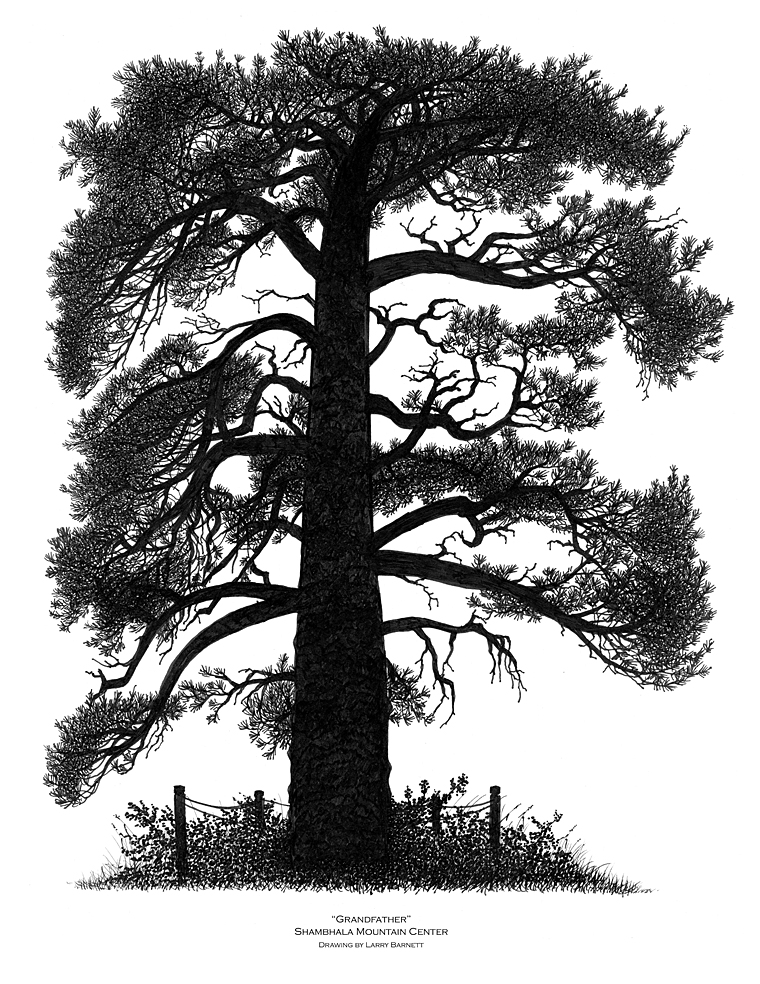
grandfather_bw.jpg

The plant kingdom predates animals by millions of years, and trees are ancient masters of survival, the oldest among them estimated at 6,000 years. Without trees human beings never would have survived. What appears to us as our mastery the plant kingdom is more likely the opposite. Just ask an ear of corn.

In great trees we witness the union of heaven and earth. Embodying qualities of both firmness and flexibility, they reveal the secret of longevity, as well as balance and grace. If misfortune strikes – wind snapping limb or trunk – the strongest of trees transform secondary growth to primary. Despite their twisted form such trees demonstrate life’s indomitable spirit, inspiration to those among us who succumb to depression and blame.

This is why I am drawn to trees and why I like to draw them. While outwardly it may seem that one tree is like another, no two trees are exactly alike. To draw a tree properly requires understanding its nature; looking deeply to see what is really going on. The south side compared with the north; the personality of the branch tips, young bark and old.

Great trees have presence. It’s something we can feel. Occasionally, one captures that in a drawing; homage to an ancient being that has struggled and survived. Sometimes, I am that lucky, and when I am like to share it with others.

Bumps in the road

Friday, November 21st, 2008

We tend to think of life in Euclidian terms, that is to say straight lines between points A and B, negotiating space and time using the geometry of fixed shapes. Sure, we negotiate curves every once in a while, but even those we prefer to describe as smooth, dramatic arcs in an otherwise straight-forward story line. We view the bumps of sudden and harsh disruptions in our lives as aberrations in an otherwise predictable and consistent experience, generally relying upon our sense of continuity to fill in the ruts and potholes of life. Our plans, habits and routines are built upon assumptions of a stable ground of day-to-day living, as if the world is a featureless two-dimensional plane upon which we simply attach the predictable perpendicular character of our lives.

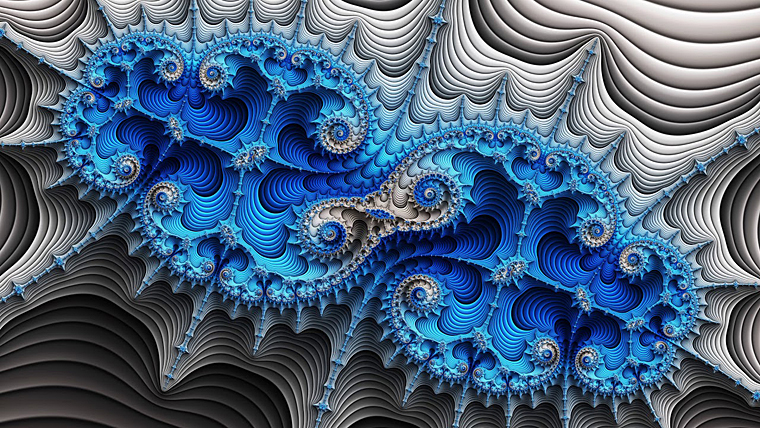
Reality is otherwise. We inhabit an irregular universe of non-Euclidian geometry characterized by an endless succession of unpredictable bumps, gaps, peaks and valleys. In this sense, life is better described as fractal, the organization of intermittent and temporary recurring patterns of order arising within the turbulence of chaos. In a physical sense, this is accurate; the objects we perceive as smooth are shown to be otherwise when examined closely.

For example, the earth appears smooth and round when viewed from space, but when viewed from its surface is revealed to be irregularly featured with towering mountains, vast plains and deep valleys. So it is when we magnify the surface of an orange or a peach. What we take to be a featureless, regular geometry is actually a rough boundary interface of endlessly smaller pits and valleys, right down to the tiniest atomic particles. Accordingly, measuring absolute circumference is not possible and is dependent upon the precision of our tools of measurement. As such, a fractal view illustrates the paradox of “beingness” that allows an infinite distance to exist within a finite shape, including us.

In a metaphysical sense, our pattern of existence mirrors the physical pattern of fractal geometry. Our days are finite, yet our actions, thoughts and deeds are unconfined and infinite. Out of the natural disorder of an inconceivably complex system we create recurrent patterns of culture, behavioral and social forms that allow us to conduct our lives and generate somewhat predictable outcomes. Within the actual chaos of the universe, we inhabit a brief self-replicating fractal island which appears to exhibit Euclidan-like stability. We negotiate our lives and make plans within a cognitive and cultural framework that exists as a mere membrane upon the surface of a chaotic reality subject to incessant change and dramatic upheaval. This is the actual ground of our existence as human beings, not the featureless plane of flatness we imagine; thus we experience hope and fear, joy and sadness, suffering and pleasure.

Viewed against the backdrop of economic and social turbulence, environmental climate change, illness, accident, and natural disaster that comprise the workings of the world, our Euclidian habit of attempting to impose order may seem foolish. Yet, as thinking and feeling beings we cannot do otherwise. The economy may tank, our crops may fail, our loved ones may suffer, but this is the nature of reality. Ultimately, all we have and have ever had is each other, and we alone are capable of intentionally bringing compassion and love to a chaotic world.

On Muttness

Friday, November 14th, 2008

At his first post-election news conference, President-elect Barack Obama referred to himself as a “Mutt.” Specifically, he said, “…We have two criteria that have to be reconciled. One is that Malia is allergic, so it has to be hypoallergenic. There are a number of breeds that are hypoallergenic. On the other hand, our preference would be to get a shelter dog. But obviously a lot of shelter dogs are mutts — like me.”

Obama is not generally one to let impulsive remarks slip, and given the entire story he recounted, it’s clear he had thought this about before and may have even planned to tell the dog story when appropriate. His motivation may have been to lighten things up with some humor, but in his uniquely daring way, he managed to make a profound statement about his own self-image, and his image in the media and public’s mind.

Our president-elect never referred to himself as a candidate for the position of America’s first black president. In fact, he studiously avoided positioning himself that way, as well as generally downplaying the significance of racial politics, excepting his extraordinarily straightforward speech on racism delivered during the height of the Reverend Wright uproar.
 
Yet upon his election, virtually every newspaper in the world hailed his election as America’s first African American President. Despite Obama’s sidestepping the topic, race was the “elephant in the room” that nobody could ignore. The “Bradley effect” was discussed openly, and Obama even joked about it himself on The Daily Show with Jon Stewart when he was asked if his white half would vote for his black half. And then came his casual self-designation as “Mutt,” a comment that dropped former Fed Chair Paul Volker’s jaw in obvious shock.

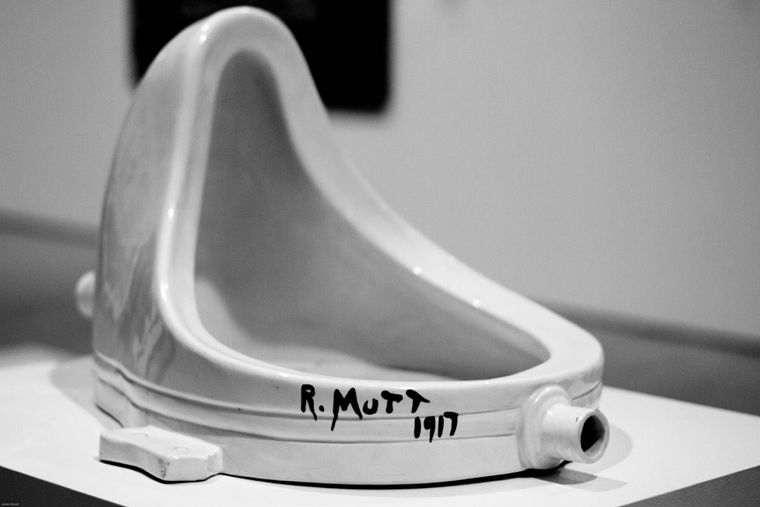
I believe the last public figure to invoke the “Mutt” metaphor in a major way was Marcel Duchamp (1887-1968), the French artist whose work presaged both conceptual art and pop art. As one of his so-called “readymades” using existing objects, he placed a men’s urinal upside down on a pedestal for an art exhibition, titled it Fountain and signed it “R. Mutt.” In this landmark 1917 work, as in others, Duchamp blurred the distinction between the everyday object and the art object, the elevated and the ordinary. He simultaneously ignited and defused emotions about what constitutes art, and for that matter, any conception or projection of value placed upon objects or ideas.

By placing himself at the center of “Muttness” Barack Obama has artfully challenged our own conceptions of self-identity and the ways we think we are perceived by others. Like Duchamp, Obama points to our collective and individual “Muttness” and forces us to confront the way in which self-identity is framed through arbitrary racial, social and class distinctions. Notably, we are all mutts, by-products of blended genes that can be traced back to the dawn of proto-humans in Africa over four-million years ago.

In calling himself a Mutt, Obama acknowledges the actual reality of his mixed racial history, but his manner indicates it’s perfectly ordinary, no big deal. Had a media pundit referred to Obama as a mutt, like Jimmy “the Greek” he or she would have been hounded out of the job. Obama has brilliantly defused the energy of the epithet and wisely marked his acknowledgement of the “elephant.”

I think Marcel Duchamp is smiling.

Congratulations, you got the part!

Saturday, November 8th, 2008

Hollywood is falling all over itself in anticipation of a truly effective 3-D technology that can move cinema ever closer to a simulacrum of actual reality. When I was young, 3-D was already in the theaters, but we had to wear cardboard glasses to see it. One lens was red and the other was blue. I can’t honestly say they worked terribly well, but it was a kick sitting in our local RKO Theatre wearing goofy glasses. And of course, you could take them home with you and walk around the neighborhood looking goofy, too. Perhaps this was the root of the psychedelic ‘60s.

When the horror film Tingler came out in 1959, staring the creepy actor Vincent Price, rumors circulated that some theatre seats were specially wired so as to produce strange tingling effects. It may have purely been a good PR story, but I certainly was a bit nervous about my own seat. From time to time someone would scream in the dark and we’d all wonder if they were in “the seat.” A sort of mass hysteria took hold, one scream quickly following another, until finally a uniformed usher with a flashlight would walk down the aisle to enforce some peace and quiet. An usher with a flashlight was actually scarier than the movie.

Later on, some movies were released with artificial airborne scents, designed to stimulate the senses and further increase the excitement of young audiences. I don’t recall smelling any movies (though some of them did stink), but I do remember the exciting fragrance of real melted butter on fresh popcorn.

We go to movies and comfortably immerse ourselves in “another world” of make-believe. Gazing at oversized images of people otherwise not unlike ourselves, watching events unfold amid dialogue and story lines, swept up by conflict, love, violence and tenderness, our attention is steady and our minds alert. At its best, our internal chatter comes to a complete halt, and we intently follow the action moment to moment as it unfolds, having completely let go of our own internal preoccupations and concerns. And this is without 3-D, fragrances or wired seats.

The great irony, of course, is that we already star in our own continuous full-color 3-D movie, complete with full sound track, endless odors and every possible physical sensation. It’s called life, and is far more complex than anything that can be created in Hollywood. Nonetheless, we are irresistibly drawn to something else.

Why do we eagerly pursue an ever more life-like movie experience when we are in fact already experiencing more than any movie can deliver? Our readiness to watch actors assume fictitious roles and play pretend people resonates, I suppose, with suspicions about the solidness of our own identities. Such inquiry inevitably leads to examining the nature of self, a matter so complex and difficult to resolve that entire religions are based upon its contemplation. Is the self a permanent single unified entity or a temporary malleable construction of various pieces?

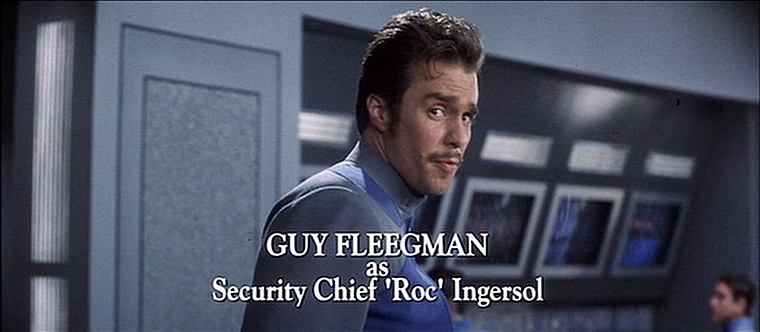
I will not presume to answer these questions, but I will admit to finding both life and movies entertaining. What can I say? Like Sam Rockwell playing the hapless crew-member Guy Fleegel in the sci-fi/comedy movie Galaxy Quest, when asked why he is always grinning confesses, “Hey…I’m just jazzed to be on the show!”

It’s the end of the world as we know it

Monday, November 3rd, 2008

Listening to today’s everyday commentary makes it sound as if the end is near. The climate is changing, the economy is faltering, our resources have been degraded and threatened, population continues to increase among the world’s poorest people, reefs are dying, fish populations are collapsing, and we are mired in endless war. Yet, have things ever been any different?

Imagine having lived over the hill from Attila the Hun; now I’ll bet that was no fun. Every time he’d set out with his army he’d pillage the community, steal the food and the women, enslave the men, behave badly and exhibit terrible table manners. If one managed to avoid the worst of it, life would be difficult nonetheless. It was terribly depressing, I’m sure, to walk home after a hard day at work and see you neighbor’s head stuck on a pike.

Or take the influenza pandemic of 1919. Worldwide, 40 million people died, and this when the population of the world was less than 2 billion people, as compared with over 6 billion people today. Nearly every family suffered a death, or knew a family that did. My father was born in 1919…one of the millions who lucked out.

Need I mention the horrors of Hitler, Stalin or World War Two? Talk about gruesome. No doubt many thought that terrible war was a clear indication of the end of the world. As technology has improved, so has the efficient technology of death, and sadly, we continue to kill each other constantly. Populations starve, die of disease and drown due to flood, hurricane and tsunami. All-in-all, if you care to pay attention, it’s not a pretty picture.

This year’s presidential election has ramped up anxiety to record levels. Clouds of racial politics, media manipulation, fears of militarism and allegations of inexperience have all combined with dire predictions of possible world-wide economic depression; it’s certainly difficult to maintain a joyful and positive attitude with all this negativity floating around.

Yet, coping with catastrophe and disaster is the stuff we are made of, and our capacity to endure, carry on and survive is the true tale of humanity. In the 4th Century Avatamsaka (Flower Ornament) Sutra of Mahayana Buddhism, the name given to this world of ours is “Endurance,” and that is something we humans do best. I don’t consider this depressing, though I am fully capable of wistfully imagining an enlightened world called “Shining Light of Wisdom” and what life might be like there. I’ve set aside such day-dreaming, however, so that I have time to pay the bills.

Actually, our legendary capacity to endure reassures me, and helps reduce my anxiety and panic over the current crumby situation in the world. Of all the many misfortunes that can befall us, the only thing I can think of that would end the world as we know it is global thermo-nuclear war; short of that, humanity will go on in one fashion or another. We will no doubt suffer, and at other moments we will enjoy life, but to suppose that after at least 100,000 years of endurance the human race is about to run out of steam plainly just seems foolish.

So, don’t worry all the time; we’re gonna be all right.