Archive for July, 2008

Speaking with silence

Thursday, July 31st, 2008

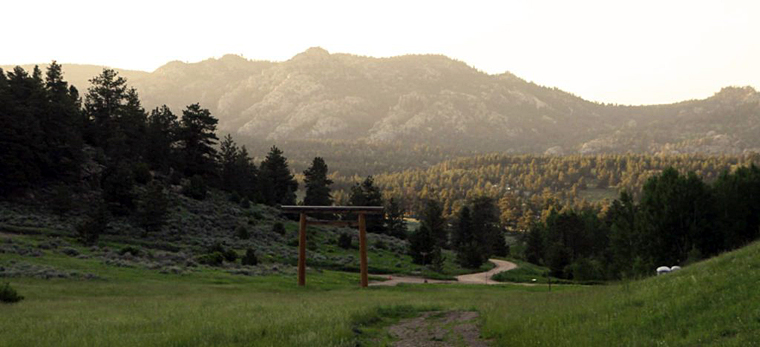
On retreat in the mountains of Colorado, amid alpine Ponderosa pines gnarled and majestic, Aspens shivering in an afternoon breeze, sudden gusts of wind, torrential rain, thunder and lightening followed by crystal clear blue skies, I sat in silence for fourteen days with ninety others. The silence was not total, but each day always began in silence which lasted until after the mid-day meal; some days were entirely spent with no words spoken at all.

In silence and stillness the mind eventually settles and internal chatter slows. As the urge to speak recedes emotions heighten. Feelings intensify, senses quicken, colors brighten, natural sounds become more obvious, and the air feels sharper. Awareness grows: the wind whispers in far-off distant waves, washes over the craggy peaks and hissing ever louder flows across the tree and grass covered valley floor. Like a great beast, our huge white tent inflates and deflates, as if breathing. A Mule Deer family wades into a small pond nearby, swallowing water in deep gulps of relief at our arid 8,000 ft. elevation. A mated pair of hawks call out to each other from the highest tree tops declaring that this is their home, their land. In a moonless night, the Milky Way stretches in a distinct glowing arc from horizon to horizon, the sky so filled with stars that space itself seems flannel soft. In silence, it seems, everything is changed.

Despite the wordless quiet, food is properly prepared, delicious meals cooked, served and eaten, dirty dishes washed, tables cleaned, floors swept, carpets vacuumed – all the necessary jobs are done, each of us taking responsibility for one task or another. We become masters of gesture – wave of the hand, nod of the head, flick of an eyebrow, a simple bow, a quick smile. Ninety strangers have come together and begin to live like close family – caring, careful, thoughtful.
 
No advocacy or argument in silence; opinions, points of view, and objections disappear. By necessity, courtesy becomes the currency of communication, and wordless acts of kindness our local economy. We gather up each others’ dishes, hold doors open, wait patiently in line, and smile in recognition. The silence and the sitting meditation practice have made us sharp and soft, alert and gentle, aware and compassionate. With each passing day we sink ever deeper. We have fully fallen sway to the grace of silence.

Before words, before thought, before dreams there was silence. We actually dwell constantly in silence, and need but quiet mind and body to sense it. It speaks to us in its own language, one ancient yet familiar. Sometimes we try to run from silence with distraction and entertainment, but we cannot actually escape the reality of whom and what we are.

Like clouds, we arise within emptiness, take shape for a short while, and then simply fade away. Confused, we want ourselves and all we love to remain solid and lasting and so we suffer terribly with the fear and sadness of loss. In silence, though, we hear and know the truth: that we are cloud beings that will not last, not one of us, absolutely none at all, and that you, and I and everyone are of the same perfectly pure primordial energy which has always glowed, glows now, and will yet glow forever.

The Marriage of Abbott and Costello

Thursday, July 24th, 2008

The recent decision of the California Supreme Court affirming the right of same sex couples to legally marry marks a welcome step forward in affirming virtues of compassion, legal equity and benevolence. Of greater significance, it brings law into line with justice, recognizing that the ties that bind transcend social convention.

Of all social conventions, those of sexual identity are among the most complicated and confusing. The fear and frustration some feel about sexual preferences points to the ways in which our own sexual identities often confuse and confound us. Brought up to be “nice little girls” and “tough little boys,” the imperatives of sexual identity begin early. In infancy of pink or blue the die is strongly cast, not solely due to parental conformity, but also because we search for ourselves within our children, including our sexual identities. Fathers see themselves in sons, and vice-a-versa. So it is with women and their daughters. As such, this is a natural inclination borne of generations of cultural and familial lore and custom.

Simple friendship between members of the same sex is so ordinary and essential we don’t give it a passing glance. Truly deep friendships are quite rare, however, and as we grow older we come to appreciate the uniqueness of real trust and affection. In times past, this intimacy produced great bonds of companionship, as can be felt within the passionate letters sent between Abraham Lincoln and his dearest friend Joshua Speed. Culturally, what’s to be made of Laurel and Hardy, Abbott and Costello, and The Three Stooges, men for whom sharing life (though comedic and theatrical) included money, food, beds, and love – if not sexual intimacy?

For those who grow up and find themselves sexually attracted to others of their own sex, society has drawn a line. Some point to religious dictates in justification, while others resort to logical arguments about procreation. Still others point to historical custom and convention as reason enough. Our sexual strictures have forced people into hidden lives of shame, distrust, and deception, despite the fact that those who are gay or lesbian have always been part of the human family, and always will be.

Thus it is the recent court ruling brings such relief. With this decision the reality of sexual preference is fully acknowledged and along with it the dignity, respect and legal protection that all citizens deserve. Society is degraded not by the reality of homosexuality, but by the discrimination against and marginalizing of those who are perceived as different. For individuals secure in their own sexual identities, the preferences of others are no threat. Those who feel threatened need to explore and come to understand the roots of their fear; no small task perhaps, but who said life is easy and uncomplicated?

Receiving and giving love to another is a rare and beautiful occurrence – being able to publicly commit oneself in the pride and devotion of marriage is yet again more beautiful. Who among us have so perfected love as to judge that between two others? If feeling joy in others’ happiness is too great a stretch, then fairness dictates one simply live and let live. Love and sex, admittedly, are confounding. As the poet-songwriter Leonard Cohen says, “I am not the one who loves. It’s love that seizes me.”

A webocracy of disembodied relationships

Friday, July 18th, 2008

In his far-reaching and prescient 1996 work “The Network Society” author Manuel Castells opined that society will increasingly form around electronically processed information networks. Society has always involved the formation of networks, but in the past these were generally personal and socially driven. Even when such networks became national in scope, interaction and contact were personal, either by letter, telephone or face-to-face visit. Moreover, the depth of information that was available within any network was constrained by the physical limitations of printed materials and their mode of transmission.

Today’s networks are driven by the likes of Facebook and MySpace, YouTube Yahoo and text-messaging. Likeminded individuals retain anonymity behind screen names, exchange thoughts and ideas, create forums and spawn online “communities.” Few participants, however, will ever meet face to face. The 2008 presidential race will largely be funded, conducted, won and lost online.

A rapid cultural transformation is taking place and our conception of self is changing alongside it. The conception of self has always been mutable, its definition and expression dependent upon the social framework surrounding it. Some find self-expression within a group, while others find it outside. Though we view ourselves as autonomous individuals, the content of social networks we inhabit becomes the reference points for our definition of self. The nature of the all-encompassing electronic network society is so far-reaching, diverse and global, however, that traditional cultural reference points are becoming increasingly irrelevant. Countries, regions, cities and neighborhoods are receding as formative frames of reference, while topicality and niche interest boldly assert themselves.

A new electronic form of cultural opinion-making has developed, loosely called “Webocracy.” Webocracy utilizes the collective expression of internet opinion to establish a hierarchy of ideas and values. By tracking the popularity and the expression of “themes,” sentiments and user activity within blogs and websites, analysts determine trends in the movement of ideas within networks on an ongoing basis. Far surpassing pre-web paper-based sentiment surveys or periodic ballot voting for example, webocracy mines the entirety of communication across and within online networks, continuously sorting and arranging information and data so that it can be reviewed easily. It is then possible to quickly adjust marketing strategies, news feeds, propaganda, and advertising campaigns in response to the collective “sentiment cloud” continuously forming and dissipating in cyberspace.

Our humanity is merging with machine intelligence. Granted, we have always inhabited the uncertain territory of trying to distinguish that which has emerged within self from that which has emerged without; it is through this give and take we define ourselves. Yet as today’s electronic network supercedes historically traditional social groupings in a continuous and accelerating spiral of input and response, pinpointing the source of self emergence is becoming more difficult. The rapid-fire, aggregate collective outpouring of individual expression is increasingly forming the content and context of self, and we now share a near light-speed mutual experience of virtual life, unencumbered by distance or physical contact. Body language, non-verbal cues, pheromones, tone of voice, and sexual contact are, however, sadly lost in a webocracy of disembodied relationships. Perhaps this is how it feels to be a ghost.

Author and futurist Ray Kurzweil has dubbed the complete convergence of self and machine technology “singularity,” and, he says it is near. Strangely, I think I can smell it.

A lover not a fighter

Friday, July 11th, 2008

I like the idea of a President who works tirelessly for the benefit of others, struggles to solve problems and strives to build a better tomorrow. I’ll tell you what I don’t want in a president: a fighter. The prospect of another fighter in the White House makes me want to crawl into a hole. And I don’t mean a fox hole.

Despite the lessons of the playground about playing nice, America seems to be terribly attached to fighting, and some presidential candidates talk like it’s great. They’ll fight for this and fight against that; illegal drugs, rights of business, entitlements, abortion, poverty, terrorism, trade, wages…you name it. All problems, it would seem, can be solved by fighting. If we’re tough enough, some say, nobody will push us around, but many regions of the world are running rings around us – not through fighting – but through economics and trade. The European Union is making hay with the Euro, China is leaving our balance-of-trade in the dust, Saudi Arabia is laughing all the way to the bank, and Russia just elected the chairman of their biggest oil corporation (Gazprom) as its President – all this while the dollar drops to an all time low, along with our respect in the world.

Indeed, we were the world’s single super-power once, a short decade when the Soviet Union collapsed. At that time, China was still crawling out of its Mao-inspired xenophobic national neurosis, and the European Union was gaining its sea legs. Convinced that success in the world was based on the ability to fight, America continued and continues to this day to invest countless billions in weaponry and militarism. We splurge on defense, while our global friends and competition, having brilliantly learned the ways of capitalism from us, swiftly move ahead on their own to cement trading partnerships and international relationships based on cooperative economics. Like a fading dream, America’s self-image as the heroic fighter is dissolving in the dust-bin of history.

Aggression may have its legitimate place in the survival of the species, but as a matter of 21st century national and international policy, it causes far more problems than it solves, as our war in Iraq amply demonstrates. An army of emergency relief aid workers would do far more to increase American influence in the world than bristling battalions. A navy devoted to the health of the oceans would surely earn us international acclaim. The rest of the world does not see fit to house its military on bases all over the globe. Moreover, as the planet’s largest arms dealer, we continue to nourish the very violence we decry. Our government supports brutally repressive governments, justifies torture and imprisons without trial; what does this behavior say about us to the rest of the world, our commitment to freedom and human rights?

I yearn for a President who will love the world, not fight it – who will radiate benevolence and decency into its darkest corners without resort to violence. The last thing the world needs now is more aggression; what the world needs now is love, and lots of it. It may sound sentimental, but it’s true. Generosity, patience and compassion alone can reestablish America’s moral leadership in the world.

I continue to hope: if only.

Vox Populi

Friday, July 4th, 2008

For twelve years on the Sonoma City Council I spent two Wednesday nights a’ month singing praises and damning failures. Now my Wednesday nights are spent just singing.

Vox Populi, a new Sonoma Rock and Roll Chorus, is the brain-child of Mark Dennis, my yoga teacher of four years, local artist, talented musician, and my friend. For years Mark has had the fantasy of forming such a chorus, and several months ago, he finally did it. About 30 of us have been singing together – Beatles, Crosby Stills Nash & Young, Van Morrison, Leonard Cohen – all arranged by Mark who commands the group with great aplomb and humor. If instead of saying, “Let’s begin” he said “Down Dog” we’d drop to all fours and dutifully point our tailbones to the ceiling. Like any choir master worth his salt, Mark is the boss…benevolent but relentless, he impels us to perfection.

Many of you may have the seen the recent documentary “Young at Heart” about a rock and roll chorus of senior citizens, average age 80. It’s a well-made and quite moving film, and leaves no doubt that singing as a group has not only provided companionship and stimulation, but has actually extended and enhanced each group member’s life enormously.

Vox Populi is a mixed age chorus, but I’d say most members are old enough to already know many words to the songs we sing. It’s an odd thing about getting older, the body changes but for most of us the memories and mind stay sharp. So singing songs I first heard forty years ago feels absolutely natural; these tunes are in our blood, and singing them together in Mark’s five-part harmony feels just great.

From time to time I stop singing and simply listen. We’re getting pretty good, despite the on-and-off attendance and regular appearance of new faces. In fact, I’d say that on occasion, we sound sublime, and in some magical way, when it happens we all feel it. There’s a moment’s pause, our eyes connect, and we just know something extraordinary has occurred. It’s nothing anyone of us could do alone; it takes a village to make choral music.

It’s delightful to discover that someone you know but slightly or solely in another context has a lovely singing voice. The gentleman who made copies for you, a local architect, a masseuse, a hospice nurse, a therapist, a teacher; all of a sudden politics and points of view, attitudes and incomes become irrelevant. It is a simply joyful exercise of humanity-in-common, doing something people have been enjoying forever.

The musicality is glorious, yet the laughs and camaraderie are even better. There is so much in life we let divide us from each other – opinions after all are a dime-a-dozen. In reality, we all share the special gift of being human and a primordial inheritance of establishing connection that predates points-of-view. Singing uses neural pathways that are not the same as used in speech; this is why people who speak with a stutter can sing flawlessly. The flow of song excites an ancient sensory network, one embedded deeply at the core of our human experience.

Mark tells us we will be singing in the Plaza Amphitheatre at 1:30 on the Fourth of July. Not for money, by the way, just for love.