Archive for April, 2008

Desire that’s perfectly pure

Saturday, April 26th, 2008

Holding four-day old Isabelle, our first grandchild, on my lap and gazing at her features, I could not help but think about how this new world looks and feels to her. Isabelle’s world is a non-conceptual one unfettered by distinctions, discriminations or structured thinking, a completely unified and totalistic experience of feeling and sensation.

Unlike adults who cannot but judge and formulate a rationale for each feeling, Isabelle simply is and does. Having been born into the human realm of desire, she already has needs, namely for food and close physical contact. She undeniably experiences pleasure and pain and responds accordingly; these experiences are not yet imprinted with intellectual or conceptual meaning of any kind, since rational thought itself is a construction of language and language is well beyond the ken of any four-day old. Thus for Isabelle, life’s meaning is a tapestry of simple needs, textures, tastes, sensations, colors, sounds, smells, and temperatures. Soon enough she will associate a sound with a sensation and a smell with pleasure, but it will be a while before she contemplates these things. For her, all that arises is fresh, each moment rich with sensory information, and all of it wordless.

At some point soon, a name will become a thing for Isabelle and her world will begin to change. A specific sound will predictably invoke an outcome, and resonant anticipation and response will develop within her. We are hard-wired to accomplish this remarkable feat, making words into things, and our brains, evolved as they are for social interaction, build such connections quickly. Yet there is also an element of separation that accompanies this process of emerging consciousness, a substitution of otherness for oneness, the duality of this and that. Our mental representations of the world merge with the world itself, our simple desires change to passion, and direct experience submerges into a rich and ever deepening matrix of associations and thoughts. Our individual identity, built upon this foundation of dualistic substitution, eventually results in a conceptual ego/self that spends a lifetime proving and justifying its own existence until finally, along with our aged material selves, it too dissolves and disappears. But I digress.

Newborn Isabelle expresses the perfect purity and unblemished nature of life itself. Harboring no artifice, no falsity, no blemish of contempt, she is like a tiny golden bell that rings true. Her contact with others is unconditionally honest, Isabelle holds nothing back; like spring sunshine bathing all without discrimination, she is a force of nature.

Like all grandparents, we feel Isabelle is the cutest and most adorable baby ever born. Every grandparent says this, but in this case, of course, it’s entirely true. Admittedly, I’m hopelessly smitten. Time will pass quickly, though, and soon she will be a walking, talking little girl filled with endless questions and opinions. We will read books to her, and push her on the swings. We will show her how to use a fork and talk to her about eating vegetables, school, boys and love. Perhaps, if we are lucky, we will hold and get to know her children as well.

But today, to cradle her in my arms while she grasps my pinky in her tiny hand is to experience the pure and wondrous grace of human goodness with which we all are born.

Anger and Racism in America

Thursday, April 17th, 2008

In his lengthy speech about race and politics, candidate Barack Obama made a point of distancing himself from the historical anger of racism, choosing instead to focus upon reconciliation and acceptance. He challenged us to shift our view, though he fully acknowledged the legitimate bitterness and disappointment felt by so many for so long when it comes to racism in America.

With one-in-fifteen black men currently incarcerated in American prisons, drug sentencing rules that impose higher penalties on crack cocaine than powdered, enormous unemployment within black communities and fewer opportunities for higher education and quality jobs than for others, Afro-Americans have cause to feel bitter. These problems notwithstanding, members of the black community have nonetheless extricated themselves from the cycle of poverty, unemployment and incarceration, and Senator Obama himself provides ample evidence of the power of the individual to overcome obstacles.

America’s racism is deeply historical and so embedded within our culture that its continued presence is often virtually transparent and therefore easily denied. Author Derrick Jensen, in his monumental work “The Culture of Make Believe” provides insight into America’s transparent racism by tracing its lengthy historical roots, and the ways in which it manifests both subtly and overtly. By transparency, Jensen means an ongoing aspect of culture that affects us and our behavior but of which we are not conscious. In that sense, transparent racism is akin to the subconscious, affecting our feelings and actions without our direct awareness. It is this transparent quality that allows the expression of racist and bigoted statements to be made by some so shamelessly in public, as if they are widely accepted truth.

Linguistically our western culture embeds values and meaning into matters of color itself. We speak of black-hearted evil villains. Heroes wear white and have hearts as pure as snow. Cowards are “yellow,” we don’t like “brown-noses” and Darth Vader implores Luke Skywaker to join him on “the dark side.” While we cannot avoid our idiomatic linguistic conventions, it is well to recognize both our cultural color biases and the ways in which such embedded psychological meaning mediates and influences our perceptions and opinions of others.

Europe’s sordid 400-year history of black slavery and its incorporation into the legal framework and economy of the emerging American nation, the systematic annihilation and organized genocide of the “red-skinned” Native American peoples, the centuries long exploitation and degradation imposed upon the immigrant “yellow races” of Asia, and the continuous inflictions of bias against the “brown” people from Central and South America are more than just sidebars in elementary school American history text books. These facts of depredation represent the workings of deep-seated racism that have stained the very fabric of American culture.

Senator Obama spoke of his personal experience of growing up with overt and transparent racism. He spoke of the anger and racism of his church’s black preacher as well as the prejudice of his white grandmother. Though some react to the exposure of our unattractive inner selves with denial, anger or dismissal, for others the window to understanding our own deep-seated bigotry begins to open. As such, his thoughtful and reasoned speech was a courageous, unique and meaningful event in American political life. Whatever the Democratic primary outcome, Barack Obama has rightfully earned his place in U.S. history.

Life among the broken hearted

Friday, April 11th, 2008

Like many other medical patients confronting mortality, I have had to come to terms with my broken heart. No doubt our modern American lifestyle has made its contribution to heart disease – super-sized portions, trans-fat and processed foods, refined sugar, high-fructose corn syrup, lack of exercise, the stress of commuting, and the overall speedy pace of life are all factors.

Yet, when one comes to terms with heart disease, we need contemplate that organ which sustains us physically and also metaphorically and spiritually is the repository of our deepest feelings. We cannot say for sure from where love is born, but its connection with the heart is undeniably suffused with cultural meaning. And sorrow is heart-felt too, as are pride and jealousy and compassion. As the focus of our emotional life, the heart is far more than just some muscular organ that generously beats 103,680 times each day on our behalf.

As the leading cause of death in America, what are we to make of all these broken hearts? Are they simply hardened by sclerosis due to our over-fed and sedentary western lifestyle or is there something else at play? The answer, perhaps, lies not in medicine, but in metaphor. Clearly, there is something afoot about our American life that is breaking hearts by the millions.

We humans are tribal and social animals by nature, as are most primates. Our public and private devotion to family, sports teams, neighborhood, city and country all speak to this. While there are those who savor some solitude or crave privacy, by and large it is in the company of others that we find our hearts at play. Through others our emotions and our feelings are stimulated, and through intimacy with others most of us discover our truest selves. Alone, we may retreat into reveries of devotion, fantasy and imagination, but without others there is little reason for poetry or art. For human beings, life unshared is barely life at all.

Alas, our modern times, crowded as they may be, nonetheless are often lonely. Despite a common ancient heritage of living in small tribes in the wild savannah, today we spend our days and nights in boxes, as sheltered from others as we are from the elements. Fear and loathing abound; we lock ourselves securely behind doors and are fed a steady stream of televised dramas of aggression, cruelty and harm inflicted against others. We insure ourselves as best we can against the probabilities of disaster, ironically betting money against our own good fortune. We hoard possessions; afraid of thieves or swindlers, all too convinced that the accumulation of material things will bring security and comfort. Even our families are often splintered and dispersed. In short, we are profoundly separated from each other, lacking frequent intimacy and the common embrace of generous and selfless love. More than Big Macs or corn-syrup-sweetened Coca-Cola, it is the loneliness of modern life that hardens and breaks our hearts.

The heart drugs, bypass surgeries, vascular stents, pacemakers and angioplasties are all good medical therapies as far as they go, but none address the deeper metaphorical meaning of broken hearts. It is, I believe, only through loving open-hearted generosity and kindness – by cultivating softness and trust – that the hard and broken heart can truly heal.

The Nature of Natural

Thursday, April 3rd, 2008

When it comes to today’s marketing of products there is no word more powerful and effective than “natural.” Natural evokes the primordial benevolence of nature and qualities of purity, freshness, and beauty. It is used to promote food, deodorant, candles, clothing, cosmetics…almost everything non-electronic is now marketed as natural, no matter what its origin of manufacture or ingredients.

What is the nature of natural? Some posit that only things arising from nature are natural, and that things created by humans are by definition artificial. Others opine that because human beings themselves arose from the natural world, everything created by humans is therefore natural. In that case, then by definition everything is natural.

Humans are exemplary tool-makers, but other animals make and use tools as well. Chimpanzees, for example, have been observed collecting and preparing sticks they use to capture termites for food. Birds and other creatures use artifacts of nature to construct intricate nests, burrows and elaborate structures of many types. Thus, one may argue that the handicrafts of people are no different than the handicrafts of birds, and hence both are natural. Think woven Indian baskets.

Birds and chimps, however, do not utilize manufacturing technology. Whatever the nature of their creations, they use only the materials of the earth, modified perhaps by their paws, pincers, body fluids or organs. Therefore, the definition of natural might mean something not derived from aggregated components resulting from compounds not otherwise arising from nature. According to this definition, objects derived from chemistry, the use of fire and heat or cold, manufacturing technology, and the transformation and recombination of elements using various forms of energy are not natural, but artificial. Think plutonium.

The evolution of corn from a primitive, tiny-seeded plant to the domesticated fat-kernel variety we consume today, however, required no sophisticated technology whatsoever. In fact, the history of agriculture, until recently, is the history of breeding plants based purely on the observation of characteristics, and the intentional propagation of plants with favorable food qualities. Thus, it appears that the application of human intellect and sensory awareness alone can modify natural things, and encourage dramatic transformation.

Clearly, it is difficult to describe the nature of natural and it is this difficulty that has facilitated the widespread, liberal use of the word natural in so many applications, many of them seemingly highly inappropriate. Think outdoor-fresh-scented fabric softener.
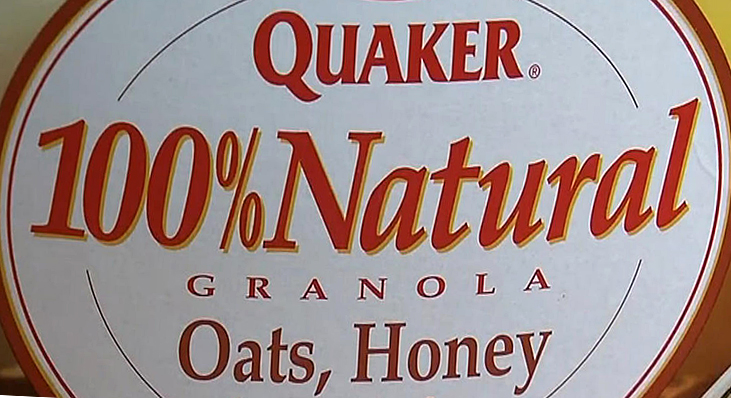
Ours is a culture that can transform anything into a commodity, including concepts and words. This is precisely the basis underlying trademark law; the commodification of the imaginary concept so that financial investment is protected and profit can be made. If the word “natural” had not existed for so long, it might well have been trademarked and its use limited to the benefit of one company solely for its product. Think Quaker Natural Granola.

Ultimately, we understand and interpret the meaning of natural in a completely subjective manner. The word has become so ubiquitous in advertising that it is now an almost meaningless adjective. In another age, perhaps, an alternative term may arise to signify those elements of experience which manifest without human encouragement or participation. Of course, since language is also a human creation, such a term will inevitably be subjective, as well. Our confusion, you see, is also entirely natural.