Archive for March, 2008

The dysfunctional democracy of America

Sunday, March 30th, 2008

For most of human history, society and government have been organized in other than democratic form, including many variations of monarchy, autocracy, and theocracy. In this day and age, we tend to speak of these other systems in a highly pejorative way, and view democracy as the pinnacle of governmental systems.

Historically however, one can observe that despite the obvious pitfalls and inadequacies of non-democratic forms of government, human culture survived and thrived under it for many thousands of years. In fact, much of what we now take for granted – agriculture, science, writing, monumental architecture, exploration and art – was a direct by-product of past non-democratic cultures. Thus we may conclude that despite shortcomings, non-democratic forms of government were none-the-less capable of supporting an enormous advance of human culture over the ages.

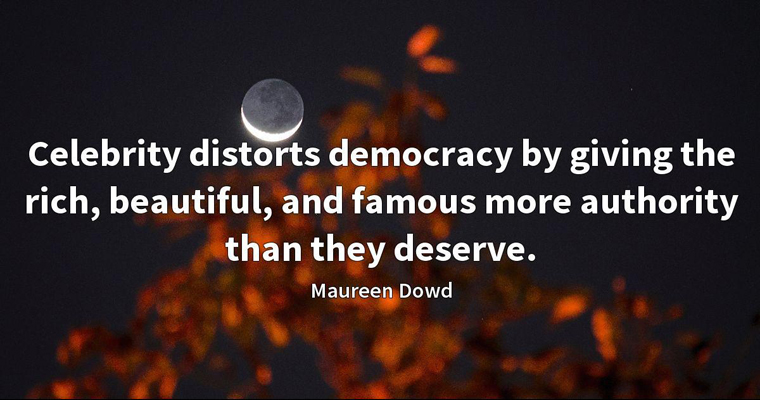
The renowned Greek philosopher, Plato (427-347 BC), was no fan of democracy, and in his comprehensive work the “Republic” he offered specific criticisms. Overall, they included his concern that “popularity contests” will not produce wise nor effective leaders, that democracy too easily falls under the control of tyrants, and that decisions made by an uneducated and uninformed citizenry will be poor. These are legitimate concerns, all the more so for American democracy as the number of voters declines, the quality of information available to the public decreases and the mass media is controlled by only a few huge multi-national corporations. Moreover, as the popularity contest mentality of our electoral process ever more resembles a Hollywood Oscar gala, personality cults dominate politics instead of thoughtful discussion and debates become opportunities for 30-second finger-pointing sound-bites that get replayed endlessly by a media far less interested in educating the public than holding audience attention for commercials.

While the parliamentary system is not perfect, at least the leaders of the parties that attain the highest office have experience in leadership and have gained the confidence and respect of their peers. Here in America, we suffer the repeated indignity of the election of ambitious yet tepid leaders with limited experience and vision, lacking in benevolence, insight or wisdom. Accordingly, they often resort to saber-rattling and aggression to prove their talent, sending young boys and girls to war to demonstrate how tough and resolute they are.

Democracy, if it is to be effective, requires an educated, engaged citizenry capable of understanding the complexities of governance and policy development. The “innate wisdom” of the individual is not enough to insure that we elect good leaders, nor is blind allegiance to our calcified winner-take-all two-party system. The hostile polarity demonstrated in our national and state government masks a serious underlying dysfunction that points to the need to immediately reassess our governance and the structure supporting it. The complexities and problems of modern society and the world at large reveal that our 200-year-old version of democracy is now incapable of developing a cohesive and consistent vision of the future, and a plan of how to get there.

Unless we begin a process of structural change in our democracy, including the validation and support of a true multi-party system, preferential ranked-voting for elective offices, increased and fair media access for candidates, and comprehensive campaign finance reform that eliminates influence peddling, we risk seeing our democracy fall prey to all the ills foreseen by Plato, and worse.

Hard work, thrift and the new American Way

Friday, March 21st, 2008

Once upon a time, when people in America wanted to save money and build up a little nest egg for the future or to pass on to the kids, they used to work hard and be thrifty. A dollar saved here, dollar earned there, and over the years most people could set a little something aside for a rainy day.

With today’s gas prices and wackiness in the housing market, lowering interest rates and a slow economy, it’s harder to plan for the future and harder yet to save for it. However, of all the factors that influence savings, it’s our crazy tax code that’s most important. In a world-turned-upside-down sort of way, postponing and avoiding taxes has become the number one inducement to save money.

Paying taxes was once something fairly simple and uncomplicated, and for some who are employed and don’t earn very much, it still is. However, for many others, tax preparation is a time-consuming and costly affair, requiring a professional. More and more, the professional advice is about postponing and avoiding taxes, and it is the government that has encouraged and created this weird situation.

I suppose nobody has ever enjoyed paying taxes, but it always seemed to me to be a moral obligation. Insuring that government had what it needed to fix roads, protect our coast, maintain safety and security, and helping in my own small way to make sure that happened felt fair. Even knowing that others might be paying less was fine…after all, I have had more than enough of what I need for comfort.

Now in my 40th year of working for a living, I’m not sure if my wife and I have enough money saved to retire comfortably. Accordingly, we still work hard every day. Yet, it is discouraging to know that in order to save money, it is how we “work” the tax code that really makes the difference. Postponing or avoiding taxes, it seems to me, is a far less satisfying motivator to encourage savings than the pride of working hard and being thrifty, but our government seems to have concluded otherwise. By making IRAs, ROTH IRAs, 401k and stock market investment the primary inducements available, the government has effectively disconnected us from the values of thoughtfulness, hard work and thrift. This, ultimately, has created a nation where tax avoidance makes good citizens, a twisted symmetry that is as confusing as it is just plain wrong. Rather than a virtue, thrift has been discarded in favor of obsessive consumerism fueled through usurious credit card debt. How crazy is that?

The savings rate in America is terribly low, and some argue that the current policies and philosophy of making taxes the key to stimulating savings is a brilliant plan. However, by using taxes as punishment for not saving money, the government serves to infantilize our adult population, reinforcing an image of citizenship as a childish role requiring the adult supervision of government. Mature qualities of self-reliance, inventiveness, common-sense, industriousness and patience are discarded in favor of tax accounting gimmicks and playing with money. Such attitudes are reflected, sadly, in our economy as a whole, wherein we have abandoned the creation of tangible things of lasting value and the wealthy accumulate additional wealth solely through the tax code.

It’s How You Play the Game

Thursday, March 13th, 2008

When Watson and Crick revealed the structure of DNA to the world, science concluded that genes were destiny. At the time the double helix blueprint containing millions upon millions of individual coded genes seemed to be of such magnitude and complexity that it would forever be beyond the reach of science to unravel the mysteries of the human genome.

With the help of automated computer programs and highly sophisticated procedures, however, even this monumental task has yielded to the prying eyes of science, and the mapping of the human genome’s three billion DNA base pairs each containing approximately 25,000 genes has now been completed. The genetic blueprint, it appears, has been decoded, classified, categorized, delineated and is now available for manipulation, augmentation, modification and commerce.

As so often happens, the conclusions we reach as we reduce the material world into its component parts are never the whole truth. With each curtain parted, yet another is revealed, and as we peer deeper into the nature of things, our previous conclusions are rapidly discarded. No sooner have we developed the ability to read our genetic blueprint than our assumptions about inheritance and genetics have undergone another upset, yet again. This time, it is in a field of study called “epigenetics.”

Science has long known that the myriad genes of DNA express themselves in living things in myriad ways. A specific gene in one person may be expressed, while the very same gene in another will not. This “on/off” function of gene expression is not fully understood, but environmental, physical and even emotional factors seem to be involved with activating or stopping gene expression. Thus each individual manifests not only the outcome of his or her genetic blueprint, but the cumulative effects of being in the world altogether.

What has only recently come to light, however, is the way in which the experience of being in the world can not only affect the genes within an individual, but actually affects the genetic inheritance of that individual. This is what the study of epigenetics is all about. We are learning that stress or hunger, for example, when experienced at an early point in life, not only turns on or off certain genes in an individual, but affects that individual’s future descendants. Recorded in the genetic memory, these events resonate through time. The stressed and hungry eight-year, it turns out, old affects the health and longevity of his grandson. We are not talking here about mutation, the genes do not change; it is more like a long-lasting resonance.

Thus, the genetic blueprint is akin to a musical score; we can see the notes and even read them, but of equal importance is the way in which the notes are played. The same piece of music can be played many ways, slow and mournful or light and lively. Like genes, the notes themselves don’t change, but tempo and mood transform the score. Moreover, how our genetic notes are played transforms not only our selves, but our offspring as well.

So once again, we come face to face with the stunning complexity of being in the world. Despite our desire to get to the bottom of things and discover the meaning of life, it eludes us in a galactic symphony of interrelatedness that places the very idea of separation firmly into the realm of ordinary confusion.

On Making Dogs of Heroes

Thursday, March 6th, 2008

Scratch deeply enough at the hide of any hero and you will find some dirt. Commonly, we refer to “feet of clay” when we find fault in those we first admire, but today the art of finding fault has reached new lows.

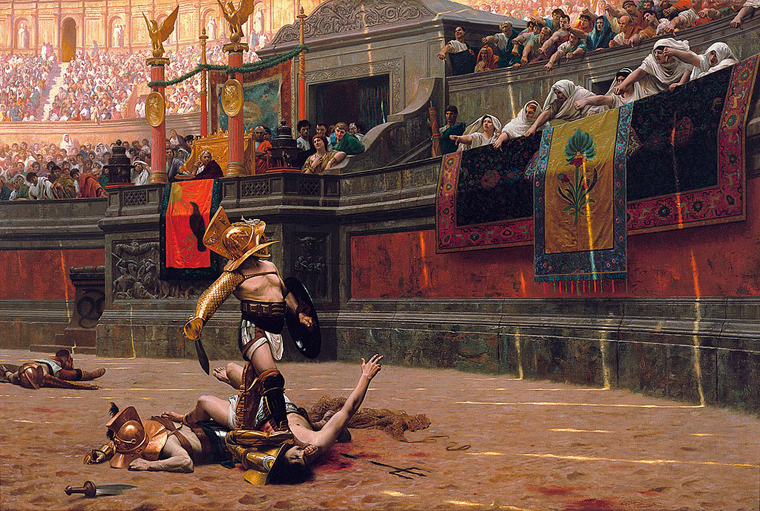
From “gotcha” to unearthing youthful indiscretions, planning “sting” operations, “outing” others, or implementing dirty trick campaigns, our voyeuristic fetish for watching people squirm under the glare of public attention borders on the obscene. Nowadays, the cognoscenti prefer saying “schadenfreude,” a German term meaning “to take pleasure in someone else’s misfortune.” “Roman Holiday,” a more colloquial term used to describe the pleasure derived from watching others suffer (as in torn apart by lions in the Roman Colosseum) seems more apt. Our dull daily news has been eclipsed by the media’s favorite pastime, the evisceration of the famous – admired public figures and otherwise. Those who say today there is no such thing as negative publicity may be technically correct, yet I aver such spectacles engage not the best in us, but the worst.

Crass and mean-spirited mass-media personalities of print and broadcast may enjoy high ratings and stratospheric salaries, but they demean us with their careless cruelty. Trading on the misfortune of others is a low and easy trick, an unseemly craft plied by the arrogant while disguised as “journalists” or “critics.” These perpetrators coolly try to justify their behavior with sanctimonious pronouncements about “evil doers” getting what they deserve, but in the end, those who prey on misfortune reveal the true scoundrels among us.

There are crimes for which the famous and the fabled deserve justice, and it is for this we have The Law. Too often so-called crimes of those who hold the spotlight are simply stupid or foolish indiscretions of which even the best of us are guilty.  Who among us have led perfect lives unblemished by mistake or bad judgment? If nothing else, the art of living in the public eye requires risk and courage and it is only through benevolence and forgiveness of each other that one prevails at all. The enjoyment of baiting, trapping or lying in wait to expose another’s faults degrades the decent, and transforms adult society into a childish schoolyard, where immature bullies who enjoy taunting others find their courage with the mob.

Those for whom fame is but a by-product of honest public service most easily endure the suffering of close scrutiny and exposure; sincere and heart-felt effort on behalf of others makes strong armor. For those invested purely in self-aggrandizement and personal profit, the lawyer and the publicist, hired guns with allegiance to mere money, are their only defense. Indeed, since it is money that’s so often behind our Roman Holidays, negative publicity feeds many mouths, however distasteful.

Our culture pays a mighty price for this corruption of virtue. Denied heroes, we become cynical and negative, suspicious and cunning. Our children, as well, lose heart and confidence in others as one role model after another is pilloried in public for the “crime” of simply being human.  We would do well to turn away from such sordid “entertainment” and instead embrace a just and benevolent view of others, as we ourselves would hope to enjoy when in time our selfsame faults may be revealed.