Archive for February, 2008

Non-Obstructed Interpenetrating Simultaneous Arising

Friday, February 29th, 2008

The ability to concentrate our attention and focus precisely upon an object or a thought requires filtering and mediating our experience of the world. Our five senses afford us the ability to detect information only within a limited range. Our eyes perceive certain wavelengths in the visible spectrum, just as out ears detect limited frequencies of sound waves. Taste and smell are defined by the capabilities of tongue and nose, while touch various from highly sensitive to somewhat dull. Sensory abilities vary person to person, but they generally fall within a predictable range.

Other animals perceive the world quite differently, of course. Bees see a world of ultraviolet light, dogs follow the most modest scent for miles, whales communicate across oceans, elephants use their feet to feel low frequency vibrations produced by other elephants and birds and insects utilize magnetic fields to navigate.

Within our physiological limitations, people must nonetheless filter our experience of the world, lest we become overwhelmed and over-stimulated. Autism, by some, has been described as a set of mental/physiological reactions due to the inability of mind to filter the flood of sensory stimulation that constantly comes our way. Despite the illusion of “multi-tasking,” we cannot actually do many things at once; rather, multitasking is simply a rapid shift of concentration from one object or moment to another.

Some experiences, like driving a car, allow us to enter into a peculiar concentrative state in which broad awareness of the environment is required, as opposed to a highly narrowed, tightly-filtered focus. Driving is an activity during which our perception must be tight enough to quickly detect events needing attention, but not so tight that we lose our ability to detect happenings at the edges of perception.  Moreover, we respond quickly and without thinking, relying almost entirely on sensory perception to safely operate a vehicle. Sometimes called “naked attention,” we have this talent because our senses naturally evolved within the world as it is, and we are comfortably familiar with its physical laws.

Yet, we exist in an infinite universe of interpenetrating realms of existence, including multiple visible and invisible forces, fields, dimensions, organic and inorganic objects. From the miniscule neutrino to the enormity of a galactic cluster we exist alongside myriad known and unknown realms which interact seamlessly and simultaneously in dramatic or subtle ways.

For those of you who have driven a car and know first-hand the type of concentration I’ve described, I would like to suggest a little experiment. Find yourself a comfortable chair, and as if you were behind the wheel of a car, sit upright and alert. Become sensitive to what is immediately around you, and let your awareness of light, color, sound, temperature and movement grow. Stay loose, but not too loose, and see if you can do this without getting distracted. Be focused, but also be aware of the panoramic edges of your perception. Hold that state of concentration for a minute, and then let it gently fall away.

We generally view time as a continuously moving chronological stream which carries all objects and discrete events within it. However, it’s also possible to perceive a timeless totality – the non-obstructed, interpenetrating, simultaneous, constantly new and fresh emergence of everything at each moment. And all this, moreover, while we ourselves simultaneously arise, arise, arise.

If Animals Could Talk

Friday, February 22nd, 2008

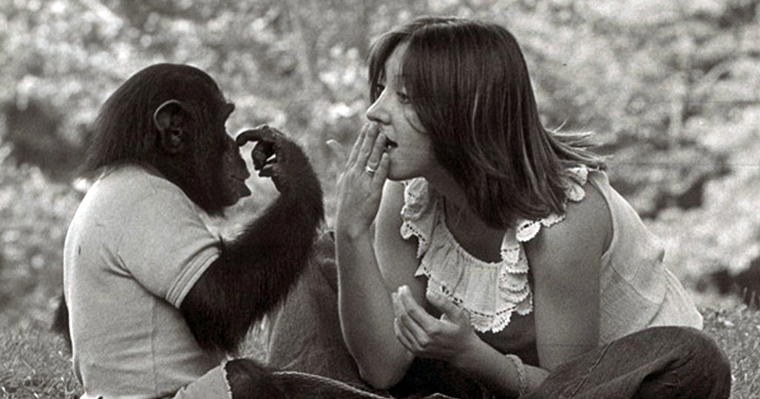
I recently noted the passing of Washoe, the 42 year-old chimpanzee that became a pioneer in human-chimpanzee communication. Washoe was taught to use human sign language and the manipulation of symbols to communicate, and researchers claim Washoe was able to construct complex sentences and engage in abstract thought. She also, like Amelda Marcos, reportedly developed a fetish for shoes.

Animal communication, of course, does not require language, but simply vocalizations, body postures, expressions, and gestures. From mating displays to signs of dominance or submission, communication in the animal world enables survival and adaptation. For as long as humans and animals have coexisted, a unique form of cross-species bonding has occurred. Dogs, horses, cats, monkeys and many other animals form meaningful relationships with people, and traces of this history are widespread within our culture. Automobiles named “Mustang,” “Jaguar,” “Ram,” and “Cheetah,” are but a few of the names we use in acknowledgement of this heritage.

For those of us who have had a pet, the emotional connection that is formed feels natural and shared. Despite the intellectual and behavioral differences, there are many qualities in common between us and our animal friends, not the least of which are a sense of companionship, dependency, protectiveness and playfulness. To imagine that these emotional components in animals occur in isolation from deeper mental constructs is absurd. Animals are subject to strong habitual patterns and instinctual drives, but these need not be viewed as entirely replacing some thoughtfulness.

The human capacity for “recursive” thought has long been considered that which distinguishes human beings from other animals. Recursive thought is that which connects a series of “if/then” concepts, each built upon the concept that precedes it while at the same time retaining the links between. Such lengthy abstract recursive streams of logic can be extended in an almost infinite direction. It seems that sign language has revealed the capacity for recursive thought in other animals. It is worth considering, however, whether we are helping animals by providing them new methods of human-like communication, or simply satisfying our own scientific curiosity while causing such animal subjects great confusion.

Like Washoe, Koko the Gorilla demonstrates a complex and intriguing personality, filled with the expressions of tenderness, humor and even irony. She communicates in sign language about the softness of a kitten, and her own feelings of loneliness. Separated from natural relationships with others of her kind, she is a perennial child among humans, treated kindly, but always apart. And having been provided a complex language to communicate with people, Koko also communicates her neurosis. In Koko’s case, she has developed a persistent fetish about nakedness and nipples. Unclothed herself, it is no surprise that she is fascinated by our removable coverings. This development underscored a lawsuit filed by a female employee who felt pressured by Koko’s keepers to undress for Koko. We certainly can’t blame Koko for this man-made legal and psychological mess and I am not saying that Koko needs the help of a Gorilla psychiatrist, but what responsibility do we have now that Koko can communicate in human terms?

In any event, as to the ageless question, “If animals could talk, what would they say?”- in Koko’s case the simple answer seems to be, “Take off your clothes.”

The World As It Is

Friday, February 15th, 2008

It seems just like any other ordinary day, when Wham! My father suddenly ends up in the hospital – seriously anemic. As soon as he is doing better and things begin to feel normal again, Wham! My sister gets thrown while white-water rafting in Thailand, cracks her helmeted head into a rock and suffers serious head trauma.

While each of us spins in familiar orbit around the objects of our personal universe, we forget that from time to time an errant meteor of illness or tragedy will crater into us, gouging our fragile surface, tossing debris across everything, altering the trajectory of our lives. Wham! The powerful gravity of such situations shifts and affects everything within proximity.

We all get whammed, and when it happens our world tilts on its axis and begins to wobble. Familiar things seem strangely different, dreamlike, as if our eyes have opened for the very first time, making it difficult to recognize and relate to things as we have before. Feelings wash through us, strong currents in a highly emotional stream of consciousness, churning silt and sediment of thought. Time and space appear distorted as the comfortable symmetry of our lives is broken.

In human terms, chaos is the natural, groundless state-of-being, within which we construct and fabricate an orderly personal universe of seeming permanence and solidity. It is a continuous succession of whams, between which we relapse into easy habits of forgetfulness and comfort. In the continuity of this impermanent state of being, we naturally express our essential human nature – such as forming attachments, finding love, establishing community – our psychic and emotional response to uncertainty. Despite our differences, disagreements, opinions and beliefs, we are all in it together, rowing our boats gently down the stream. At some deep primordial level we have an awareness of and appreciation for the profound unity of our shared experience.

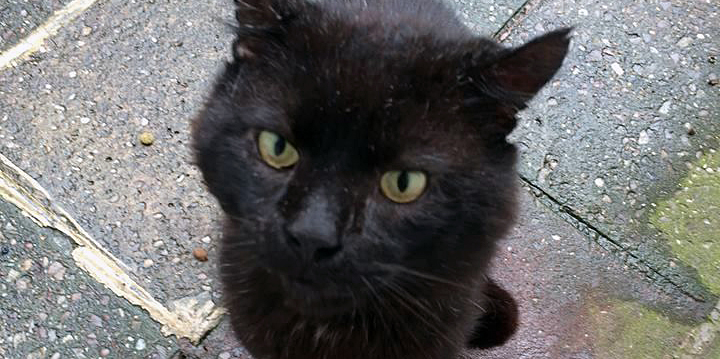
Right in the middle of my lowest low, dwelling on the prospect of my father’s decline and the possible long-term health effects of my sister’s unfortunate accident, a painfully thin stray cat wandered into our backyard while I sat contemplating chaos. She approached and rubbed her black boney head against my leg, looked up and ever so perfectly cat-like, said “meow.” Reaching down, I scratched behind her ears and under her chin. She purred. Just skin and bones – I fed her, of course. And of course, just as in the folk song, the cat came back.

After daily visits and many weeks of canned Fancy Feast and dry food, she looks much better. Her black coat is now shiny and thick, and her bones rest more comfortably under softer lines and a growing layer of winter fat. I find myself waiting for her to appear, afraid she won’t. Sometimes she disappears for days and I worry about her; when she finally arrives again, everything seems lighter. I feel that in some odd but completely proper way her timely arrival was connected to my sadness.

We cannot prevent chaos nor control the universe – we are, after all, just tiny beings made of yet tinier parts, spinning in infinite energy-filled space. Yet, we can feed and care for another being for a while, bringing comfort, and we may receive some in return, and within that simple act find an antidote to Wham.

Of Art and the Sacred

Thursday, February 7th, 2008

People have been arguing about art for a very long time. The cave paintings in Lascaux, France, are reported to be over 20,000 years old, and no doubt they stimulated considerable dialogue – “It looks more like an ox than a horse to me,” or “My six-year-old daughter can draw better than that,” or “It’s the stupidest looking pig I’ve ever seen!”  Of course, the ancient cave paintings were not an “art exhibition.” Rather, they were a visual incantation created to help insure a good hunt, more a sacred expression than creative one.

When life and art were one expression of the sacredness of the world, today’s objectified and dualistic view of art did not exist. Some cultures continue to preserve the remnants of this unity; Bali and Mexico come immediately to mind. Despite the penchant of modern culture to view “folk art” (carvings, textiles, varied crafts, painting, sculptures, etc.) as a mere decorative accessory, artistic expression as part of a sacred life is where all art began. Accordingly, art as a highly personal, purely creative, intellectual, political or philosophical endeavor associated with religious dogma, garnering public opinion or as a multimillion-dollar investment vehicle is a decidedly recent phenomenon. Indeed, while the origins of sacred and religious art is an interesting topic, its destruction and prohibition is no loss compelling.
 
When religious or anti-religious institutions and the mechanisms and imperatives of state power are merged, it has often been accompanied by the destruction of sacred art. Thus, noses were hacked off statues of Egyptian deities, heads and arms of Greek gods defaced, and Tibetan Buddhist paintings and artifacts burned by the Communists. Before they were driven from power, the Taliban of Afghanistan made a point of destroying the ancient 60-foot tall cliff-side Buddha statues in Bamiyan due to their religious/political significance. Because religious expression is easily clothed in sentiments of devotion or piety, it is regularly appropriated as a lever of state power.

Thus it is that the legal decisions regarding overtly religious displays on government and state property have been controversial, and rightfully so. While the First Amendment explicitly guarantees both freedom of religion and prohibits government establishment thereof and as well guarantees freedom of speech, conflating religious or sacred art with free-speech reignites ancient passions deeply suffused with pride and prejudice. Recent arguments proposing that religious displays on government property should be allowed as an expression of free speech do just that. Equating genuine religious displays with culturally secular popular displays such as decorated trees or Santa Claus ultimately demeans authentic faith, and undermines the sacred.

Religious displays placed on private or religious institution property clearly are fully protected under the Constitution’s Bill of Rights, but the modern day court so strongly leans in favor of insuring that one particular religion is not established by the state above another, that it has interpreted the First Amendment using a highly cautious and common-sense approach. The court has recognized that any effort to reunite state and religious expression risks exacerbating and exciting deeply felt, and even extreme emotions. In our ethnically and religiously diverse society such expressions are best kept in reserve, lest things be said or done that quickly escalate into the unwelcome territory of intolerance residing just below the surface of our multi-cultural society.

Dinner for the Vultures

Saturday, February 2nd, 2008

The excesses of the sub-prime mortgage lending industry are inevitably pointing to a huge bailout by the taxpayers, and potential collapse of housing prices overall. Due to the wide popularity home equity loans, a housing price collapse will subject many millions of homeowners to the reality of mortgage loans well in excess of the value of their homes, making it impossible to fully pay off the loan upon sale of the property.

The rise of the World Trade Organization and extensive multilateral trade and tariff agreements created since the 1980’s have been accompanied by domestic economic policies that make the control of inflation a higher priority than planning and developing a full employment economy. Accordingly, millions of good-paying jobs have been out-sourced offshore. Deregulated financial markets of the 80’s resulted in rampant fraud, and the collapse of the savings and loan industry required a massive bailout by the American taxpayer. The recent sub-prime mortgage meltdown once again highlights the worst failings of economic policies now in vogue in much of the world.

The lending industry depends upon available capital to finance its loans, and the mortgage industry has been particularly creative in packaging high-risk/high-return investment vehicles to be sold on Wall Street. Unfortunately, when things go sour, investment shifts from venture capital to vulture capital, and our financial system begins to feed instead on the economic carrion of a distressed citizenry.

Foreclosed homes are quickly devoured by vulture capitalists eager to trade for profit on the misfortune of others. Thus it is that one middle-aged man seriously suffering from complications of Parkinson’s disease who owed only $20,000 on a home equity line but was current with the same lender on his first mortgage lost track of making his equity line payments and suddenly became homeless. His house, sold out from under him in foreclosure, was only returned to his possession when the story hit the front page of the S.F. Chronicle and became a public relations nightmare for the vulture capitalists who had bought his home out of foreclosure. He is one of the lucky few.

While touting high-minded philosophy about the power and economic freedom of the individual, limiting the power of government and promoting unregulated markets, our governmental policy makers, having enjoyed the largesse of Wall Street’s huge campaign contributors, continually allow the investment community to evade the sorry results of its own excesses. Corporate bigwigs, like the CEOs at Merrill Lynch and Citicorp who presided over failed investment strategies, lose their jobs but nonetheless retain hundreds of millions in salary, stock, and retirement entitlements. The average Jill or Joe, conversely, are left to fend for themselves in an era of sharply decreased pension benefits, unavailability of affordable health insurance and virtually no job security.

The world’s wealth is held in fewer hands today than ever before in modern history. In America, the social safety net created between 1930 and 1975 has largely been dismantled, while income inequality substantially exceeds that of the 19th Century period of the “robber barons.” Ironically, while the shocking economic facts are widely available online and global communication reaches billions of people, the ordinary citizen is far too preoccupied with the daily struggle to make ends meet and trying not to become dinner for the vultures.