Archive for January, 2008

A World Beyond Words

Saturday, January 26th, 2008

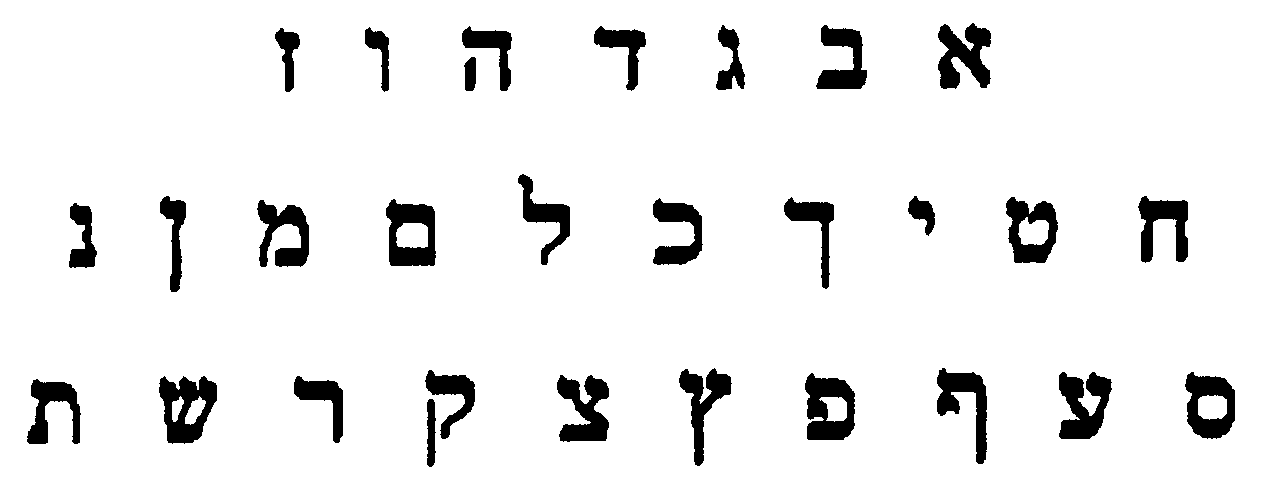
The early Hebrews created the first written alphabet, which they called the aleph-beth, which was later adapted by the ancient Greeks. The alphabet we use today is itself derived from that Greek alphabet.
 
Unlike Chinese, which uses tens of thousands of symbolic pictograms with multiple meanings established largely through context for written communication, our alphabet is comprised of 26 characters which represent phonetic sounds of the human voice. Accordingly, as we read text, a blending of our visual and auditory senses takes place called synaesthesia; we simultaneously “hear” what we see, and in this way discern meaning in printed words as if spoken. Our modern alphabetic culture and the written word have enabled us to communicate clearly by using words and vocabulary in a precise and non-ambiguous manner.

Yet the original aleph-beth of the Hebrews contained no vowels. Vowel sounds, “a,” “e,” “i,” “o,” and “u,” are active moving breath sounds, unlike consonants, which generally halt or precede the movement of breath. Author David Abram (The Spell of the Sensuous) associates this absence of vowels with the idea of the “sacred wind” revered by many ancient peoples. Incorporation of the earth’s primordial natural forces established the cultural ground of early human speech, and established its connection with what was considered a sacred world. Notably, the aleph-beth was not widely shared; the absence of written vowels determined that complete and accurate transmission of the first texts could only be accomplished orally, since written groupings of consonants without specific vowels indicated were subject to varied pronunciation, meaning, ambiguousness and misinterpretation.

When the Greeks adapted the Hebrew alphabet, they added new characters to represent the vowel sounds. This alteration facilitated the use of the explicit linguistic distinctions we now take for granted, but it also began to separate our western language from its original ground in the sensory natural world, ushering forth a protracted period of reverence for the written word itself and the fierce dogmatism that often accompanies it. We have all had the experience of being told something, and upon asking where it was heard, being told indignantly, “Why, I read it in the paper!”

For most of human history, wisdom was transmitted orally or through demonstration from teacher to student, often in secrecy. Those who received the teachings would memorize them so that they could be passed orally to others when the time was right. In this way, countless generations learned about the plants and animals, foods and tools, places and history, land and weather. Such lessons and wisdom were viewed as sacred, and preparation to safeguard sacred wisdom included discipline, apprenticeship, study and devotion. It was correctly understood that wisdom placed into the wrong hands or applied carelessly could mean the ruination of the world and all that live upon it.

The written word has great power. It can provoke anger and outrage, fear and loathing, sentimentality, empathy, understanding or ignorance. Undeniably, the written word performs modern magic, transforming thought, and thereby transforming the world. And yet, words cannot adequately describe the color yellow or the music of Brahms. Step outside and feel winter’s chill on your face; listen to the birds at dawn. As mere reference points to our original sensory experience, the written word cannot replace the profound and wordless experience of life itself.

“Hip Bone Connected to the…

Thursday, January 17th, 2008

Thigh bone. Thigh bone connected to the knee bone. Knee bone connected to the foot bone. I hear the word of the Lord!”

In its simple wisdom, the old spiritual “Dem Bones” by James Weldon Johnson neatly summarizes the true nature of the body and the reality of health care.

Modern western medicine has viewed health care as largely a matter of symptom management, though occasionally the cure is worse than the illness. This is not because of stupidity or greed particularly, rather a by-product of our point of view about the body. Instead of recognizing the biological integrity of our cells and organs, when illness strikes we tend to objectify and isolate parts of the body from one another. While this objective separation may make treatment appear easier, western medical myopia can result in unanticipated negative side effects.

The human body is composed of tens of trillions of cells, each cell type highly differentiated, and capable of communication with other cells in the body. Accordingly, there is a constant and continuous internal conversation happening within each of us, a non-verbal cellular conference of chemical and electrical instant messaging carrying voluminous information and instructions. From time to time, this bodily chorus reaches our conscious awareness and we feel hungry, thirsty, tired, joyful, depressed and so on. Often times, these feelings and sensations seem to arise from out of nowhere. In any event, those messages that reach consciousness as feelings or pain are what we could call the “gross” messages of the body, ones so substantial that they cannot be ignored.

We miss, however, is the mostly silent torrent of messages constantly being exchanged within our many trillion-celled being. If we have a headache, we tend to think there is a problem in our head, but headache can be the symptom of a problem originating elsewhere in the body. If our finger does not heal, we assume we have a problem with our finger, but the actual cause may be in the liver. If we cut our toe it’s likely that every cell in the body is informed and reacts in some way, subtle or dramatic.

Western medicine is finally coming to the realization that everything about the body is fully integrated and interconnected. Isolating one organ, let alone one cell from another, is the mere product of our imagination and constitutes an enormous misunderstanding.

Our perception of the world is of three types: (a) we are completely bewildered, (b) we misunderstand and get things mixed up or (c) we achieve partial understanding. Complete understanding, it seems, is reserved solely for the omniscient or divine. As western medicine moves from misunderstanding to partial understanding, it has come around to seeing connections between the dots. The picture that emerges is stunningly complex. Despite similarities, in its final composition each living being is unique, no two exactly alike, and each responds to the world in it its own unique way.

For a long while health care was viewed as a spiritual or supernatural issue, while at yet another point leaches and bleeding were deemed proper treatment. Today, western medical treatment is about physical and chemical causes and cures. In the final analysis, though, everything about our bodies is connected and nothing can truly be divided from the whole, except that is, in our own minds.

It’s Life and Life Only

Thursday, January 10th, 2008

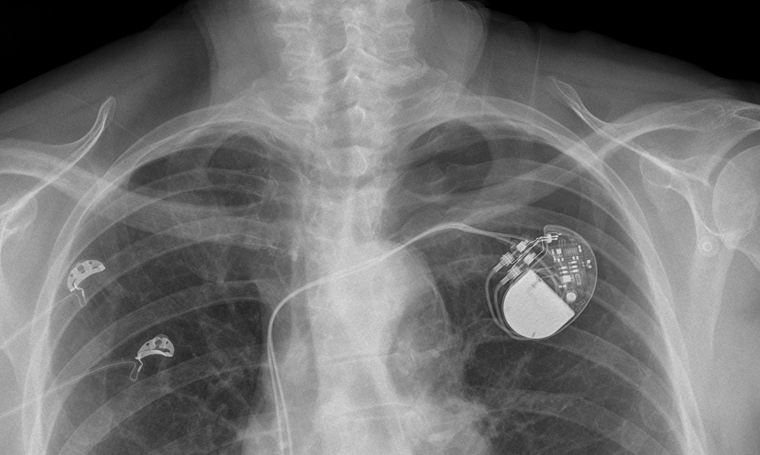
For the past seven years I have enjoyed the dependable companionship of a pacemaker. I’m not talking about a life coach or a personal trainer; I’m talking about a pacemaker that is actually wired into the chambers of my heart and makes it beat.

Actually, it’s more than just a pacemaker, and is also an implanted cardioverter-defibrillator, prepared to shock my heart into a normal rhythm should it develop a life-threatening arrhythmia. I think of it as carrying around a personal paramedic in my chest.

It’s quite odd to be bionic. I have to avoid strong magnetic fields like those used at the airports, and for some reason I don’t understand entirely, it’s recommended that I keep my distance from chain saws. The latter has posed no particular burden, as chain saws join shot guns on my list of items bearing no significant attraction to me whatsoever.

From time to time I’m asked about whether I worry about my dependence on technology. Given the way computers crash, toasters short and bulbs burn out, I suppose this question is not all that farfetched. Most technology today is built with obsolescence in mind, and in our throw-away society we’ve become accustomed to replacing our mechanical devices frequently. In the case of pacemaker-defibrillators however, the manufacturing effort seems to have been decidedly more conservative, and the rate of failure or defect is quite small. The batteries last a very long time, and when they do get low after seven years or so, the unit emits a boring little tune at 9am to remind me to call the doctor. How disappointing to discover that the choice of tune cannot not be my own; I think I would have chosen something fun, like the last refrain of Dylan’s It’s All Right Ma.

It’s true that something could go very wrong with my pacemaker, but then again something could go very wrong with any number of my major organs, blood vessels, or my mind. For all I know, something is going very wrong with them right now. The fact is that our bodies are complex and life is so uncertain that from moment to moment not one of us knows exactly what’s to come. We assume that each second will be followed by another because that’s the way it’s happened up ‘til now. The truth is we don’t know for sure the precise moment of our demise, let alone what we will eat for dinner tomorrow. Philosophers have speculated for millennia about this fact and tried to understand how we carry on each day despite being filled to the brim with uncertainty. I personally think that we owe it to our profoundly forgetful nature, and our remarkable facility to become distracted by the likes of a heaping plate of nachos and cold beer.

I recently had my pacemaker replaced by a newer one. The surgeon slipped it into the little pocket in my chest where the last one sat so comfortably. In seven years, of course, technology has greatly improved, and this new unit does all kinds of fancy stuff. Alas, it can’t open Microsoft WORD and still won’t play the type of music that I want, but then again, unless my mind shorts out, I can always hum Bob Dylan.

New Year’s Letter 2030

Thursday, January 3rd, 2008

Happy New Year! 2029 raced by so fast it’s hard to believe it is already 2030. It has been an eventful year. Our Granddaughter Lani entered Columbia University Medical School last year, and expects to perform her first remote robotics surgery soon. Larry remembers when his older brother graduated from Columbia in 1967 and then endured seven years more of internships and residency. Ever since bio-engineered accelerated learning RNA protein chain food enhancement and the consequent increase in world-wide IQ by a factor of three occurred, the pace of integration into the global network health services just keeps getting faster. Can you believe they are talking about 13 year-old doctors? Wow.

Our other grandchild, Rue, just turned 18, and has returned from her six month overseas language immersion program in China. This makes her now fluent in 16 languages, and qualifies her for a position in the International Tribunal program. Her network node includes around 35,000 language savants, who combined with the International Neural Processing Program offers instantaneous communication between any of the 7.5 billion members of the citizen community, both here, in space and even those who remain as neural processing partners in the no-body repositories of the dearly departed. Now that Rue joins them, justice will never be the same.

Larry continues his Sanskrit and Buddhist studies, and spent six months in cyber retreat this year. It appears that the combination of meditation, the newest time-release hyperbaric nano-medication and his very cool new stem-cell grown bio-engineered heart seem to have solved his periodic and inconvenient circulatory problems, and it looks like he will now have the time to complete his study of tannic acid refulgence in Chinese green tea. His botanical musical compositions continue to garner enthusiastic fans among the international garden crowd.

Norma celebrated the publication of her 12th book last year, Dialogue with Immanence, and has documented over 17 million overnight Estream transmits in the first 24 hours of its release. All royalties from the work are being donated to the Psychotherapy Institute, which remains one of the few remaining therapeutic and clinical programs requiring the actual physical presence of client and therapist. Her previous book, “Yeah,” a survey of early twentieth century gospel music, was recently awarded the Jupiter Prize in Stockholm by former U.S. President Chelsea Clinton.

Like us, of course, you must be pleased to have heard about the last licensed and functioning internal combustion automobile ceremoniously crushed and melted last week at the local Fusion Energy Center in Santa Rosa. Hard to believe that we used to burn gasoline for energy and were so late to discover the actual value of the world’s remaining oil. Now that it has ironically helped to restore biological balance and halted the effects of the greenhouse effect, those of us who remember smog can only shake our heads. Black gold, indeed!

That’s about it for now. We wish you and yours a happy and healthy 2030, and look forward to our scheduled MindStream party at 5 p.m. EST, Tuesday, June 30. Be sure to plug in by 4:45 so that your cerebral cortex frontal lobe alpha waveform function can be synchronized with others and the MicrosoftAlive sensory application link can be fully optimized so you don’t miss a thing!