Archive for December, 2007

Me, Mine, Thee and Thine

Monday, December 31st, 2007

When you think about it, private property, the ownership of the earth itself, is a rather ridiculous idea. An artifact of culture buttressed by social compacts, laws, and precedent, the idea of land ownership is a mere 10,000 years old. Paleolithic hunter-gatherer culture was supplanted by fixed agriculture during the Neolithic period, and this shift was accompanied by the establishment of permanent settlements or cities. With these cities, patriarchal society, the idea of private property, armies and collective self-defense arose; hence the moat, the castle and the ever-widening sphere of physical dominion over land and others.

In North America, the spread of indigenous populations occurred over a 40,000 year period. While Native Americans certainly were territorial, the sanctity of the land was central to their spiritual beliefs, and the concept of land ownership by individuals never was established. Moreover, as enormous animal herds roamed the wilds and prairies, birds migrated and fish traveled upstream to spawn, they were free to move without restriction or constraint. Despite nearly 20,000 years of continuous and wide-spread human habitation, the North American environment remained essentially unspoiled, and the Europeans who later came to this land were stunned by its extraordinary natural abundance, beauty and pristine character.

Of course, the Europeans brought their social and cultural values with them, and among those was the concept of private property. This land was variously claimed for ownership by one European power or another in the name of God and Country. Ultimately, America became a place where a citizen could own land; first white men of power, then later on other races, and finally, women. Land ownership is now so tightly woven into the fabric of our culture that it is all but impossible to imagine an alternative.

The concept of land ownership is quite provocative, however. Since ownership conveys rights, people have been largely free to do as they wished with what they owned.  Accordingly, most forests have been cut, innumerable rivers polluted, the air dirtied, and animal populations destroyed. Viewed as natural “resources,” the blessings of this land and the land itself have been thoroughly exploited. We know that our ownership of land is temporary, and we want to make the most of it. That most often has meant and means making lots of money.  It is not that people are inherently greedy; it’s just that we can be terribly shortsighted.

Notably, we also tend to view ourselves as the owners of our bodies, ignoring the fact that like the earth itself, we are entirely composed of ancient galactic material that has been recycled continuously since the beginning of the universe. Since we think we own our bodies, we treat them like our other possessions, sometimes well, and sometimes not. In the end, of course, we will give our bodies back, right down to the last atom. In that ultimate sense, we are beggars and borrowers, all.

We humans play but a tiny part in the long history of this planet, a mere blink of an eye in geologic time. It is our outsize egos that make us feel otherwise, and it is our egos that make us think that we own the land. When natural disaster strikes, like Hurricane Katrina, the Tsunami of 2004, or an enormous earthquake, Mother Earth reminds us just exactly who owns what.

When It’s All About Nuts

Thursday, December 27th, 2007

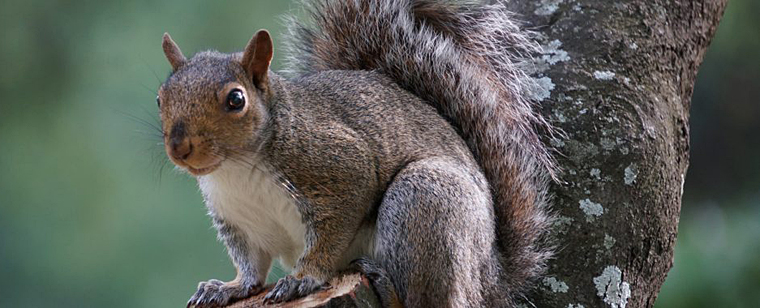
This is a heavy nut year. Last year was light, but this year the Black Walnut in my yard is dropping bushel’s full of nuts. They bounce off the roof at all hours of the day and night, and by morning the patio is littered in green and blackened two-inch balls. This is, of course, excellent news for the large contingent of Gray Squirrels in my neighborhood. They spend the entire day obsessed with nuts.

Interestingly, the squirrels prefer the nuts they pick to those that have fallen. I am not sure why they have this preference, but they do, and no matter how many nuts are available on the ground, they continue to race to the tree tops and pluck yet another from its stem.

Despite the abundance of nuts, the squirrels regard the possession of one nut as absolute. Once firmly grasped, that nut becomes private property, and if not shelled and eaten is deposited in a hole dug furtively and with great caution. Occasionally, possession of a walnut is cause for conflict, one squirrel chasing the other in frenzied spirals up and down the tree trunk. From time to time, a nut is dropped by a squirrel during the chase, and falling to the ground that nut becomes meaningless to the combatants, who nonetheless continue their aggressive competition.

I can’t help but spend time each day watching the squirrels go about their business, which consists of picking, eating, rejecting and burying nuts, and I find myself thinking about people. We are obsessed with nuts as well, but we call our nuts money.
 
Much of our obsession with money is quite nutty, indeed. Though surrounded by great abundance we suffer from a poverty mentality that makes us feel as if we never have enough. Accordingly, we hurriedly move on day-to-day in search of the next treasure. We too chase each other around in frenzied spirals in pursuit of money to bury in the bank, only to have it taken from us the next day by others who bury it in their account. We often find the money of others more attractive than our own, and regard with envy those who have more. At times anger prompts us to forget money altogether and we find ourselves fighting and competing purely out of habit. I have never seen a squirrel kill for a nut, but sadly, some people kill for money.

Black walnuts are covered in bitterness, a moist and fibrous black layer that creates a dark stain around a squirrel’s mouth. It must be difficult to chew through the bitter husk and hardness of the shell, but the draw of the sweet meat inside is too strong to resist. So it is with us and money, all too often the goal of bitter struggle with life’s hardness and our attempt to satisfy the sweetness we desire. We too can get stained, with dark rings of exhaustion under our eyes and hearts turned black from an insatiable craving for money.

Fall has arrived, and in a few weeks more all the walnuts will have fallen. The squirrels will continue to climb the tree and hunt for a while, but eventually they will move on. Meanwhile, our nuttiness continues. For us, money is always in season.

The Kindness of Strangers

Thursday, December 13th, 2007

The night before I recently flew home from New York I dreamt that while flying on Virgin Airlines the captain announced we would be making an emergency landing due to a passenger’s medical condition. In my dream, of course, I was that passenger.

The next morning we took off from JFK en route to SFO. Suddenly, one and one-half hours into the flight the captain announced “Good morning, folks. I’m afraid that one of our passengers is having a medical emergency, and we have to make an unscheduled landing in Detroit so he can receive medical attention.” Good thing was strapped in, or I might have fallen right out of my seat.

My immediate reaction was to check myself out…perhaps, I thought, I had a problem. But such was not the case; a passenger in first class was having chest pains. I’d noticed him in the boarding area, and had thought, “That guy does not look right.” Ah, well.

The landing was swift and uneventful. Our plane was met by an ambulance and paramedics quickly boarded, examined the passenger and within ten minutes had evacuated him and sped off. We sat for another hour or so while the plane was refueled, FAA paperwork was completed, and then resumed our flight.

In this day and age, had I mentioned my dream to a flight attendant upon boarding, I probably would not have been allowed to remain on the plane. Being a “kook” is no longer an act of innocence, and predictions pertaining to things that might happen during a flight are most definitely not welcome. I had, I realized, been clairvoyant, and was sorry I had not recorded my dream, put the notes in a sealed envelope and mailed it to myself date-stamped from the airport. Claims are one thing, proof is yet another, and that’s the problem with clairvoyant moments; we don’t recognize them until events bear them out. Hunches, forebodings, vibes…call them what you may; most of us have unexplained clairvoyance in our lives from time to time, to which we pay but modest attention, if any at all.  When safely back in the air, I did mention my clairvoyant dream to one flight attendant. Her blue eyes widened at the tale.

Putting aside the issue of clairvoyance, most notable was that a passenger in distress would prompt a landing and be attended by a half-dozen paramedics and fire department personnel. They swept into efficient action to help a stranger traveling from one coast to another, someone they will never see again.

The A320 jetliner weighs over 160,000 pounds, travels over 500 miles per hour, carries 150 passengers and a flight crew of 10. It’s easy to forget how complex and sophisticated the operation of modern aircraft are, and the airlines do all they can to help passengers ignore the fact that we sit in a thin aluminum tube hurtling through the atmosphere at 35,000 feet where the temperature outside is a chilly minus 55 degrees. And yet, this hugely expensive machine and all that supports it will land because a single passenger needs help. I was touched and reassured by this kindness.

As I disembarked and said goodbye, the flight attendant with the big blue eyes smiled at me. “No more dreams!” she said.

500 Words on “Why I will not talk in music class.”

Monday, December 10th, 2007

While dutifully writing my weekly 500-word essay for The Sonoma Valley Sun I realized that my 7th grade music teacher, Mr. Davies, would have been pleased to know about it.

Mr. Davies was a volcanic personality, a man of great talent and short temper. Capable of playing and teaching virtually every instrument in the school band, he struggled each week to keep us on key and paying attention. This was back in the glory days, when music and art were regular and fully-funded classes in the grammar school curriculum. Being young and foolish of course, we 7th graders misbehaved, not appreciating what a rare and precious opportunity a public school music program was. Right in the middle of singing “O’ What a Beautiful Morning,” near the line about an “elephant’s eye,” someone would crack a joke. Mr. Davies would slam his hands down on the keys, jump from his seat, point his finger at the offending student, yell “500 words on why I will not talk in Music Class!” and storm out the door. In five minutes he’d be back as if nothing had happened. He’d sit down at the piano, play a little intro, and raising one hand would lead us back into the musical cornfields of Oklahoma!

I high school, I discovered my tenor voice and joined the chorus. Walter Ehret, director of our high school music department presided, and conducted us in the Music Tower, with its dramatic vaulted ceiling high above us. Mr. Ehret, a graduate of the Juilliard School of Music and the Teacher’s College of Columbia University, was not only a wonderful conductor, but had written the arrangements for literally many hundreds of pieces of choral music. Enormously talented, he conducted with his entire body, right down to his pinky finger, and drew from us sublime moments of true splendor. And, like Mr. Davies, his temper was ferocious. A wrong note, a laugh or a whisper was enough to make him stop mid-gesture, pinky in the air and with an agonizing “NO!” that resonated and echoed off the walls he would turn on his heels and walk out, red-faced and steaming.

In two minutes he would return. We would sit in absolute silence while he strode his way to the front of the room. Nodding to the pianist, arm rising along with his dark eyebrows, his eyes would gently close and all temper forgotten, we would begin again.
I suppose that there are music teachers who are mild-mannered and even-tempered, quiet and gentle folks of endless patience. My teachers were otherwise; passionate perfectionists who tirelessly endeavored to awaken us to the magic of many human voices joined as one, beyond thought, beyond concept. They were devoted to the transformative nature of choral music, where individuals meld seamlessly in collective sound and explore a space denied the single voice.

I did in fact write a 500-word essay in 7th grade for Mr. Davies, and still recall it. After a longwinded 475-word apology about disruption, rudeness, and disrespect, I added that not talking in music class was important because singing with others was something I could not do by myself. Foolish 7th grader that I was, at the time I had no idea just how meaningful that statement was.

Falling Apart

Saturday, December 1st, 2007

I spent last week attending to my ailing 88-year-old father. Generally good-natured and optimistic, he had been laid low by a sudden painful swelling in his right knee, accompanied by weakness, chills, and shortness of breath. The combination landed him in the hospital for a week, where it was determined that he was seriously anemic, and suffering from an arthritic-like inflammation of his knee. The infusion of fresh red blood and a high dose of steroids slowly eased his symptoms, and after he returned home I flew in to offer comfort and conversation.

My father is not a patient man, and that makes him a lousy patient. When his body disappoints him, he reacts by getting angry and depressed. That reaction is not unusual; most of us react that way from time to time. This time, however, my father was afraid.

So a portion of the week was spent in conversation about dying and what precedes it. We talked of sudden death and we also talked of living while the body slowly falls apart, while legs or heart or kidneys start to fail or pain sets in. Ordinary activities become burdensome or impossible altogether, like opening a jar of jam or pulling on a sock. Meanwhile, the watcher in us catalogs the ways in which we dissolve. Shame, anger, embarrassment, sadness and frustration all appear, but the most difficult of all emotions that can arise is the fear of death.

My father, like many of us, thinks his body is like a car. If something goes wrong, we take our body to the shop to be fixed. The doctor kicks the tires, checks the fluids, listens to the engine, and then prescribes new gaskets or a fuel additive to help things run smoothly again. With replacement hips and knees and heart transplants its easy to begin to believe we are made of interchangeable parts. But we discussed how this mechanistic view of things only goes so far, serves to objectify the body and separates our conception of it from our sense of self.

Where is self found; is it in our head? Perhaps some part of self is in a finger. Surely, giving up a finger, not to mention a foot or leg is not easy.  Should that come to pass none of us can be certain what will be lost. What then to give up everything? Is it possible to fall apart and disappear and not lose touch with self? Dying begins the moment we are born, and we suffer small deaths every day. Ideas, fantasies, memories all die, are forgotten and disappear; our very cells are not all the same as those we enjoyed last night.

As the week wore on my dad felt better. He began to tell his stories once again. We chuckled and cried and I taught him how to walk with a cane. I knew he’d turned the corner when the discussion turned to politics; talk of death was gently put aside. Early the next morning I flew home.

I called him when I arrived. “I made my own lunch today,” he crowed into the phone. “That’s great,” I replied, “I know you really like it when your tank is full.” There was a moment’s silence, and then we laughed.