My life as a turnip

July 29th, 2010

In the 1974 book Lives of a Cell, author Lewis Thomas paints a disarmingly sweet portrait of a single cell that all but imparts a charming personality upon a living thing so small it’s microscopic. The life of a single cell, one of 40 trillion in each of our bodies, reflects the drama of human life itself: birth, growth, movement, maturity, reproduction and death.

Molecular biology was just on the verge of unlocking the secrets of DNA, RNA and the genetic code in 1974. In the 36 years since, the genome of human DNA, (over 3 billion base pairs comprised of between 20-25,000 protein coded genes), has been determined. The fruition of 3 billion years of natural evolution, the human genome ecapsulates the sum total of the history of animal life on earth, a genetic encyclopedia of change and transformation.

Scientists, it was announced, have recently constructed and inserted man-made artificial DNA into a bacteria cell and that cell went on to generate proteins produced at the direction of the artificial DNA and to replicate itself. Human evolution is now on the brink of sudden change. None of us can predict the precise nature of that change. What we can be sure of, however, is that at some point man-made artificial genes will make their way into living animals, and eventually to human beings.

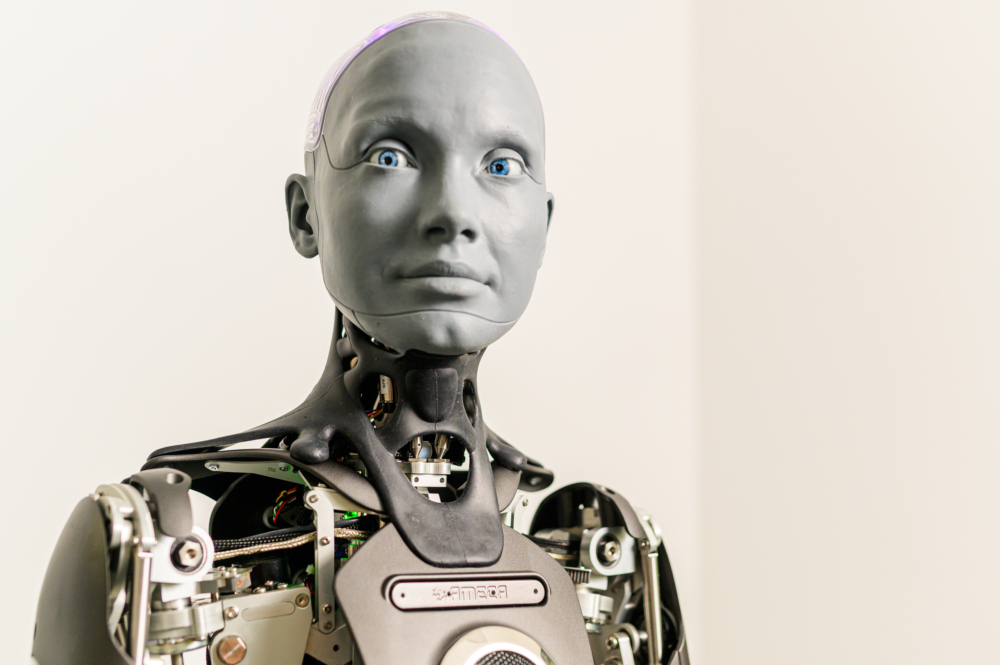
It is not without some sense of trepidation that I imagine man-made people, and in time, designer genes. Want a baby with blue skin and pink polkadots? How about hands with six fingers and eyes that glow in the dark? It may sound far-fetched, but given our proven ability to commercialize every significant scientific invention, I think such outcomes are a sure bet.

What’s less certain is what happens when we screw up. By leapfrogging over the drawn-out process of natural selection and inserting man-made genetic characteristics based on market trends and focus groups, we’re moving into uncharted territory. Nature has used an elegant, if uncompromising, methodology for billions of years: mutate, test and keep what works over a long period of time. This fiscal year’s genetic blockbuster carries with it the same risks as any other hot consumer product, and the idea of people designed according to the latest fashion trend is, frankly, horrifying.

There are few major inventions that are put back in the bottle once removed. Science has a penchant for discovery and experiment, even if that means courting disaster. The search for knowledge has produced technological miracles and the machine age is nothing short of magical. Yet tampering with the stuff of life itself makes the risks of nuclear technology seem modest. If we consider the virus and its ability to combine with human DNA in relentless pursuit of successful mutation, it is readily apparent that even a casual mistake might end up polluting both human and non-human species of animal life.

Ironically, Lewis also recounts the biology of mitochondria, the organelle within each animal cell that is essential for energy conversion. Mitochondria have their own DNA, and Lewis traces it back to the plant kingdom. The very cellular structure that gives us life may be the result of a primordial animal-plant combination. We may, in some strange way, be highly evolved cabbages, and if we are not careful, into vegetables we may yet return.

When bad words happen to good people

July 23rd, 2010

I attended a lecture today. The topic was Jews in the 21st Century, but it covered the 20th century as well. All told, it was not a bad talk, if a bit too long and somewhat repetitive. As it pertained to Israel, I found no basic disagreement with its premise that extremist intolerance on the part of both Israelis and Palestinians provides no road to peace.

However, I was struck by one element of the presentation, namely that the speaker referred to Israeli extremists as ultra-orthodox Jews while Palestinian extremists were referred to as Islamo-fascists. The speaker had gone to some lengths to decry the calling of Israelis “Nazis,” yet did not seem to notice that he was calling Palestinians “Nazis” by designating them as fascist. So, in the midst of attempting to draw a parallel between the intolerance of extremists on both sides of the conflict, he revealed his own prejudice and willingness to engage in stereotypical name-calling.

Name-calling attempts to frame debate linking people with debased behavior or characteristics. The linkage need not call upon facts, statistics, actual observation or documentation. As a pejorative device, name-calling exercises power by tapping into implicit or explicit bigotry, prejudice, small-mindedness and intolerance.

Whether it’s Rush Limbaugh calling women “Femi-Nazis,” whites calling African Americans “Jungle Bunnies,” Arabs being referred to as “Rag Heads” or extremist Palestinians designated “Islamo-Fascists,” the intent is the same: to diminish and objectify others in order to justify one’s own preferences, bigotry, hatred or aggression. In this way, fueled by intemperate and aggressive speech, cycles of conflict are propagated,.

Today’s speaker touched upon the torment inflicted on Europe’s Jews during the Holocaust, none of which would have happened without name-calling. Designating Jews as “vermin, pests and parasites” Adolph Hitler’s Third Reich and his propagandist Joseph Goebbels used language as their tool of choice in mobilizing German society to accept the extermination of millions. Today, language continues to be used as an effective agent of dominance and aggression.

Each of us forms likes and dislikes, some born of the senses and others born of experience; this is completely human. But as we grow older and examine our own views and attitudes, we often discover the roots of our preferences are wholly insubstantial. Upon close inspection we find all our stereotypes about others are wrong. Looking deeper, we can understand that our everyday speech reinforces our discrimination. Only by applying mindfulness can we discover how automatically we objectify others.

Mindful speech requires slowing down, creating a gap between our feelings and our mouths. It can be done, but it takes practice and is a challenge in our speedy culture. A good way to begin is with simple silence, listening to others then just watching our mind. Sometimes when I feel speedy, I count to three before speaking. In many interactions, a smile and a nod of acknowledgement are often sufficient.

All over the world, people inflict terrible pain and suffering on others every day. We let the differences between us become the excuse for terrible behavior. We cannot individually solve the problems of the entire world, but we can be more careful about what we say to and about others. Such mindfulness may not change everything for the better, but as my grandfather used to say, “Couldn’t hurt!”

The end of the mailman

July 16th, 2010

The handwriting is not on the wall; it’s on the computer, the cell phone, the tablet, Twitter, Facebook, Linked-In and Skype. Technology is rapidly making the mailman obsolete.

Reflecting on this brings up memories of Al Zooks, the mailman of my suburban youth. As I remember him, Al was a grizzled old guy: unshaven, white-haired, mostly bald, and sporting a semi-toothless grin. He’d drive up and down my street dropping mail into mailboxes, and chatting with most everyone he’d meet along the way. I know this because sometimes he’d pick me up as I walked home from school and let me ride along with him in his mail truck.

“Hey, Larry!” he’d shout, “Y’wanna ride?” Al’s New York accent was as thick as Molasses. I’d hop in and sit on a pile of mail – seatbelts, air-bags and Ralph Nader were many years in the future. “Sow’s the folks?” Al would ask, grinning. His missing teeth fascinated me. “Mom ok?” Al was my mother’s mailman when she was a little girl in nearby New Rochelle many years before. I imagined her sitting on a pile of mail in his truck too. In my youth trusting people you knew just seemed normal.

Around the holidays Al would attach a small plow to the front of his truck, and when we’d had a good snowfall he’d put on chains and plow a path down the driveways so he could hand-deliver the mail without trudging through the snow. He’d ring the bell on a Saturday, and my dad would answer the door. “Hey Norm!” Al would bellow, “Happy Holidays!” My father would invite him in. “Rye, right?” my dad would ask, and he didn’t mean rye bread. Al would nod his head and grin.

We’d all go into the hot kitchen where my mother would be at the stove. “Hi ya, doll!” Al would shout, and mother would give him a big hug. “Howaya?” We’d sit at the kitchen table and my dad would pour Al his shot of Rye. He’d down it with a big “Ahhh,” smack his lips and wink at me. Like our neighbors, my father would hand him an envelope with twenty bucks in it. In this way Al made his rounds, reaffirming old relationships, supplementing his salary and getting progressively more intoxicated. It was glorious.

Nowadays kids can’t ride in mail trucks, drinking and driving don’t mix, tips are not allowed, trust is in short supply, and at my house I never know from day-to-day who delivers my mail because my street has no permanently assigned mailman. The U.S. Post Office wants to eliminate Saturday delivery altogether, and most of the mail we get is junk. Our bills are paid online or by direct withdrawal, and it seems the ratio of meaningful mail to mail-order catalogs tipped in favor of catalogs quite some time ago.

Before technology, mail bound us together as a people and a nation. Though short-lived due to the telegraph, tales of the pony-express remain a romantic expression of the selfless mail-carrier braving danger and the elements to make sure people could hear from their loved ones. The personal, human to human quality of life is rapidly receding into digital networks of ever-more disembodied communication technology. The future of hand delivered mail? “Fuggedaboudit!.”

Thinking of you, Al.

Stuff Happens. Now what?

July 8th, 2010

The answer is…more stuff! The continuity of existence is existence itself – an unbroken timeless non-event in which nothing is actually ever the same, and thus never changes. In essence, nothing happens continuously.

This conundrum notwithstanding, from time to time most of us would like to stop the world and get off. This is impossible, so we retreat instead to the confines of our own familiar mind-cave, creating the powerful illusion that the stuff that happens needn’t concern us. As if in a dream we watch TV, go to the movies, read books, listen to music, nibble on chips, jiggle our legs, chew gum and accumulate possessions; in short distracting ourselves in every way possible from the groundless, ungraspable experience of continuity

Moreover, our ordinary perspective is limited not only by mental and emotional distractions but also by our actual inability to fully understand what is going on around us. Although we know that cause and effect are real and comprise the essential fabric of continuity, we are incapable of fully observing cause and effect in all their subtle manifestations so it is only the grossest and most obvious forms which generally attract our attention. Much of the time, we are bewildered.

Occasionally, we find ourselves open to a wider experience of the stuff that happens. We’re caught short by a sudden flash of color, or rendered speechless by the unexpected screech of tires braking to a hurried stop. At such moments the vividness of continuity hits us and we are suddenly and fully awakened. Our preoccupations, habits and mental constructs are instantaneously dropped, and the full power and spectacle of existence rushes through us. Labeled “peak experiences,” we quickly retreat to our “normal” view of reality and get back to the business of crawling around the safe little cave inside our minds.

There are opportunities, however, to fully and intentionally engage with the energy of continuity, and practices that can be employed to encourage and sustain that engagement. Recognizing that our natural awareness, unmitigated and unmediated by thought, is always available and is essentially of the same nature as continuity, the cultivation of such engagement is the great work of wisdom traditions stretching back many thousands of years. Culture and technology have changed, but the nature of mind has not. Thus the lessons and experiences of those who have developed methods and practices devoted to the awakening of mind remain relevant and are of great value in this materialistic age.

It is taught that true awakening arises simultaneously with the awareness of suffering. If we exit our safe little cave, we experience the unhappiness of all cave dwellers, and the profound experience of that suffering is acutely painful and heartbreaking.

Thus the engaged experience of continuity is not comfortable or without great challenge. Infinite open-endedness can feel peculiarly claustrophobic, relentlessly present and completely inescapable. There is no retirement from continuity, no turning back, no stopping the world, no time off. And despite this, having tasted the truth, retreating instead into our mental cave feels insufficient, unsubstantial and false.

Making the choice and effort to be awake and engaged is at one and the same time very outrageous and yet completely ordinary. According to the great teachers, this is the only way we can be of real help to others at all.

Gathering of the clan

July 1st, 2010

Dogs howl.
A pink twilight speaks of rain.
The ground, dear one,
Is always shaking.

My wife’s sister and our niece were the first to join us a decade ago, moving to town four blocks northwest of us. It turns out she and her daughter were an advanced guard; over the last six months our family clan has continued gathering. First my daughter, her husband and our granddaughter moved into a house six blocks southeast. That happened in December. Last week, my father took up residence in a cute apartment five blocks northwest, around the corner from my sister-in-law.

Like social animals of any kind, sensitive to the environment and wired for survival, people can sense uncertainty and threat, even when the perceived nature of such threat is clouded or indistinct. Like penguins sensing bad weather, drawn together against frigid wind, families are gathering, families like mine.

Change is in the air in America, and along with it uncertainty in great measure. I’m not talking apocalypse, though there are those who lean in that direction. There are some who say apocalypse has already happened, and has happened many times before. And there are others yet again who think apocalypse is happening right now. Ask the whales, they say.

I am talking about various signs of trouble, most of them the direct result of human activity or the effect of natural impacts acting upon it. Take note: a Gulf of Mexico deep oil well blowout, volcanoes in Iceland stranding air travelers across Europe, stock trading glitches that drop the Dow Jones 1,000 points in one hour, leaking nuclear reactor water contaminating the below-ground aquifer in upstate New York, endocrine disrupting chemicals like BPA lining commercial canned goods – something is happening. We can feel it, but as Jesse Colin Young sang years ago, “What it is, is not exactly clear.”

What is clear is that a family that was spread apart, anywhere from 250 to 2,500 miles, has gathered in one little town rather suddenly. We cross paths constantly, wander in and out of each others’ homes and lives in ways that simply weren’t possible before. My granddaughter is surrounded by love spanning four generations; in my father’s childhood such a situation was not unusual, but today it is a rarity. An explicit interdependence has arisen.

There are challenges in such interdependence, of course. Boundaries are moving and changing; privacy is not what it was. But a particular kind of security is also arising. We are no longer separated ones or twos or threes, but have each other to lean on. Think penguins.

When life is easy – jobs plentiful, health fine, money in the bank – being alone in ones or twos can work out alright. But life is not so easy right now. Something is brewing, and it’s not all good. The world is in serious trouble and just as my immediate family has drawn together, so must we as the larger family of society accept the reality of our interdependence, draw together, be kind and supportive.

Like the fiercest gales or blizzards, all the terrible storms of human folly eventually blow themselves out, and together we pick up the pieces, care for each other and clean up the mess. This is the only way a good human society has ever succeeded.